
The Middle Ground Between Outright and Each-Way
There was a tournament in 2019 when I had three players finish inside the top eight. None won. My outright bets returned nothing, and my each-way selections only covered two of the three because of place-term limits. That weekend I started paying serious attention to top-finish markets, and they have been a core part of my betting portfolio ever since.
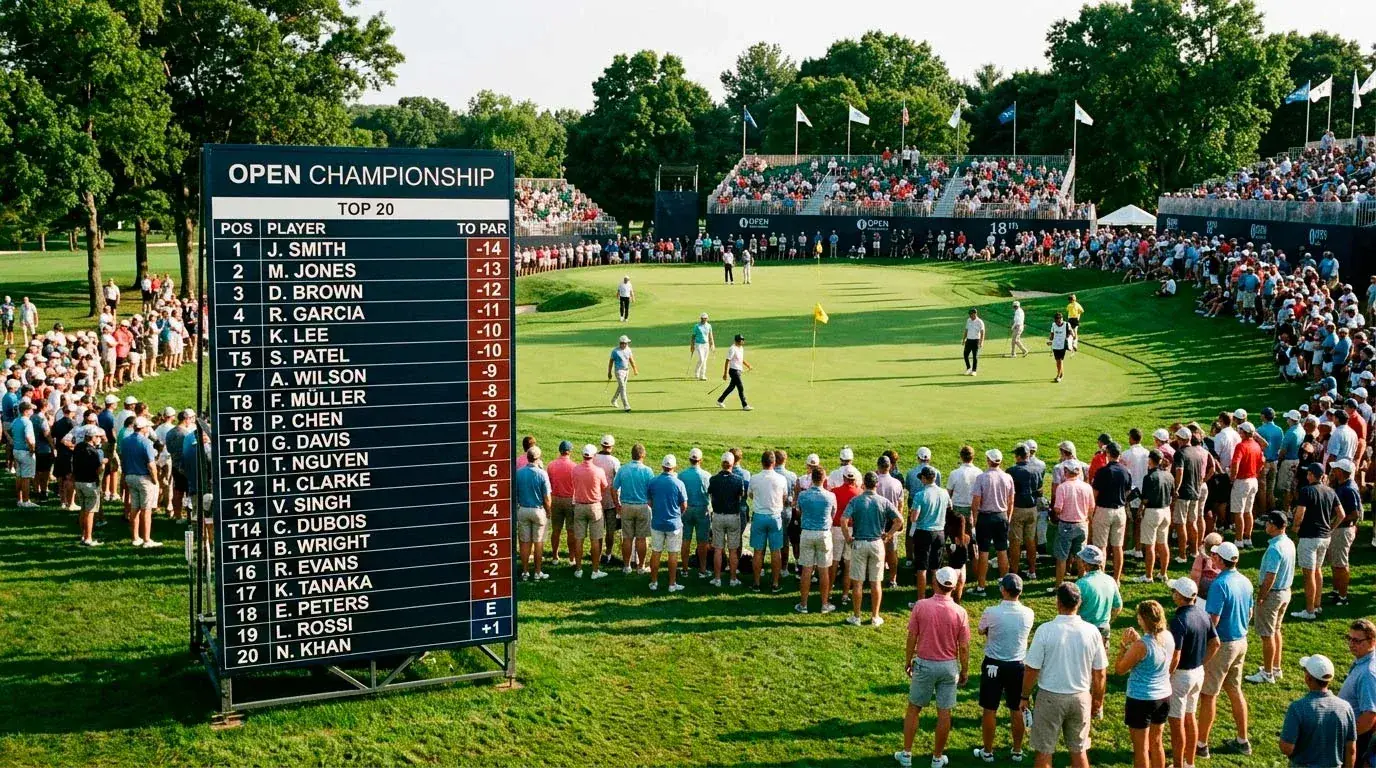
Top finish bets sit in a space that most casual punters overlook entirely. You are not trying to pick the tournament winner — that is a 1-in-156 proposition at a full-field event. Instead, you are wagering that a player finishes inside a defined positional band: top 5, top 10, or top 20. The appeal is mathematical. A top-20 bet on a quality player at a PGA Tour event might price at 2/1 or 5/2, offering a realistic probability of landing compared to the same player’s outright price of 40/1. The Masters alone functions as the fourth-largest betting event globally for operators such as Entain, and the top-finish markets around that tournament attract substantial volume from punters who understand that positional betting rewards good analysis without demanding perfection.
This market type works best for mid-range contenders — players ranked 20th to 60th in the world who lack the outright ceiling of elite names but possess the consistency to post steady finishes. If you have identified a player whose Strokes Gained profile matches a course’s demands but whose outright price does not offer enough value, top-finish markets often provide a more efficient route to a return.
How Top Finish Pricing Works
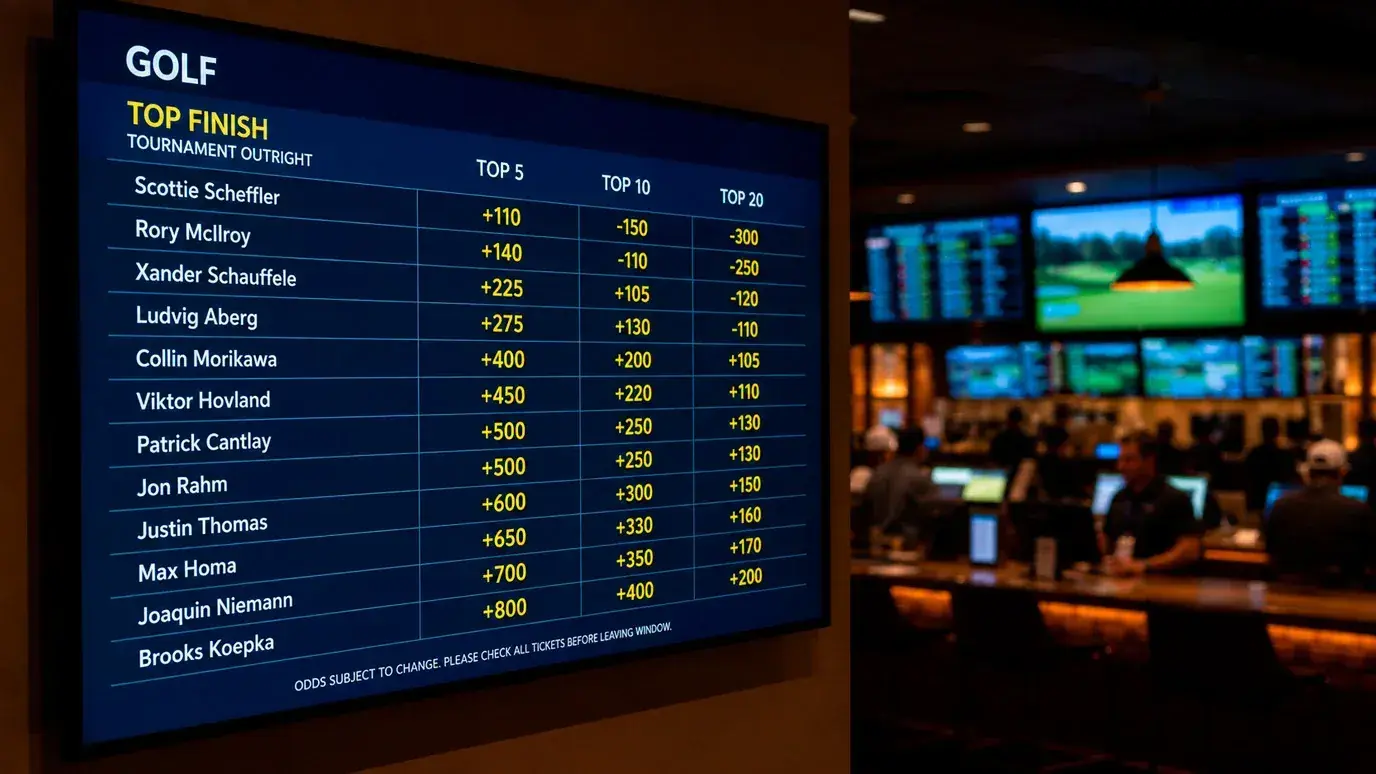
Pricing across the three main tiers — top 5, top 10, top 20 — follows a logical gradient, but the relationship between the tiers is not always proportional, and that is where informed punters find edges.
A bookmaker prices a top-5 bet by estimating the probability that a given player finishes in positions one through five. For a player priced at 20/1 outright, the implied win probability is around 4.8%. But that same player’s probability of finishing top 5 might be 18% to 22%, translating to a top-5 price of roughly 7/2 to 9/2. The top-10 probability is higher still — perhaps 30% to 35% — yielding a price around 2/1 to 9/4. And a top-20 finish might carry a probability of 50% or more, with a price of Evens to 6/5.
The margins operators embed in top-finish markets tend to be tighter than in outright markets because the probability ranges are narrower and easier for traders to model. In an outright market with 150+ runners, the overround can reach 140% or beyond. In a top-10 market offered on 30 to 40 players, the overround typically sits between 115% and 125%. That tighter margin means a smaller tax on each bet, which compounds positively over a full season of wagering.

Where pricing becomes particularly interesting is during major championships. The four majors combine to generate roughly a third of all golf betting volume in a calendar year, with the Masters alone responsible for 40% of all major-related wagers. During these events, bookmakers expand their top-finish offerings, sometimes pricing top-5 and top-10 markets on 60 or more players. That expansion stretches their trading resources and increases the likelihood of mispriced outsiders, especially in the top-20 tier where less analytical attention is directed.
Dead-Heat Exposure in Positional Markets
If there is one aspect of top-finish betting that catches punters off guard, it is the dead-heat rule. I have received enough angry messages from friends after their “winning” top-10 bet paid out at half the expected amount to know this is a widespread blind spot.
Dead heats occur when multiple players tie for the last qualifying position. In golf, this happens frequently. If your top-10 bet needs the player to finish tenth or better, and four players tie for ninth place, the market must accommodate all four. Two of those players occupy ninth and tenth, but the other two are effectively tied for those spots as well. The bookmaker applies dead-heat rules: your payout is reduced proportionally based on the number of players sharing the relevant positions relative to the number of available spots.

The maths can sting. Suppose you back a player at 3/1 for a top-10 finish. He ties for tenth with three others. There is one “top 10” spot available among the four tied players. Your stake is divided by four, and only that quarter receives the full 3/1 return. Instead of collecting four units (3/1 on a one-unit stake), you receive just one unit. The net effect turns a winning bet into a marginal return or even a loss after accounting for the full stake.
Top-5 markets carry the highest dead-heat risk because the qualifying band is narrower and the probability of ties at the boundary is higher. Top-20 markets carry lower risk because the boundary is wider, and ties at exactly twentieth are less consequential since there are more spots to absorb them. I factor dead-heat risk into my pricing by subtracting 5% to 8% from my estimated probability for top-5 bets and 2% to 3% for top-20 bets. This adjustment is crude but effective — it prevents me from overvaluing bets where the boundary tie risk is structurally high.

When Positional Markets Outperform Outright Wagers
During the 2026 Masters build-up, Betway reported that Bryson DeChambeau attracted 16% of all outright wagers on the tournament — more than any other player. That concentration of public money compressed his outright price to the point where his implied win probability exceeded what the data supported. But his top-10 price, less affected by public sentiment, still reflected a more rational assessment of his finishing probability. That is the dynamic I exploit week after week.
Top-finish markets outperform outright bets in three specific scenarios. First, when a player’s outright price has been shortened by public money rather than genuine form — the top-finish market is less susceptible to narrative-driven compression. Second, when a player is a strong course fit but lacks the closing ability or putting consistency to win outright — these players overperform their positional probability relative to their win probability. Third, at major championships where each-way betting golf terms provide extended places, the interaction between top-finish bets and each-way positions creates opportunities to construct layered positions that capture a wider range of outcomes.
The discipline required is resisting the allure of the big outright payout. A top-10 bet at 2/1 feels pedestrian compared to the same player at 40/1 outright. But after nine years of tracking results, my ROI on top-finish bets sits meaningfully above my outright ROI. The smaller individual payouts accumulate far more reliably, and the lower variance means my bankroll survives the inevitable dry spells that are inherent to golf wagering. For punters willing to trade excitement for consistency, positional markets are where the smart money has been quietly compounding for years.