


Half the Country Bets, But Most Have Never Touched a Golf Market
A friend of mine watches every PGA Tour broadcast, knows which players are in form, can name the course rotation for the next six weeks — and has never placed a golf bet in his life. When I asked why, he said the betslip confused him. Too many market options, too many numbers, and no clear starting point. That conversation is the reason this guide exists.
Roughly 48% of adults in the UK have placed a bet of some kind in the past four weeks. Another 9% wager on sport at least once a month, with an additional 13% betting less regularly but still participating. Those are enormous numbers — nearly half the adult population — yet golf remains underrepresented in most punters’ portfolios. Football dominates, horse racing follows, and golf sits in third place despite offering structural advantages that neither of those sports can match.
Learning how to bet on golf is not complicated, but it does require understanding a few things that are unique to the sport. The field size is larger than in any other betting event. The odds are longer than anything you will see in football or tennis. The tournament stretches across four days rather than ninety minutes. And the range of available markets — from outright winners to head-to-head matchups to hole-by-hole propositions — is broader than most beginners expect.
This guide walks you through the entire process from zero to your first placed bet, step by step. I am not going to assume you know what each-way means, or that you can read fractional odds, or that you have ever logged into a sportsbook. If you already know some of this, skip ahead — the sections are built to work independently. If you are genuinely starting from nothing, read straight through and you will be ready to place an informed wager by the time you reach the end.
What Makes Golf Betting Different From Football or Racing
When I moved from betting on Premier League football to betting on PGA Tour golf, the first thing that struck me was the odds. In football, a match favourite might be priced at 4/5. In golf, the tournament favourite is typically 6/1 at the shortest — and often closer to 10/1 or 12/1. That difference is not cosmetic. It reflects a fundamental structural reality: in football, one of two teams (or a draw) must win. In golf, one player out of 156 must win. The probability is spread across a vastly larger pool, which means every price on the board is longer than what football punters are accustomed to seeing.
The second difference is time. A football bet resolves in ninety minutes. A golf bet takes four days. Between Thursday morning and Sunday evening, your selection plays 72 holes across four rounds, survives or fails to survive a halfway cut, and navigates changing weather, course conditions and the psychological pressure of leaderboard position. That extended timeline creates opportunities for in-play betting, cash-out decisions and hedging strategies that simply do not exist in faster sports.
Participation in golf itself has been growing steadily, which feeds directly into betting interest. John Bushell, the managing director of Sporting Insights, described the continued rise in golf participation as “extremely good news for the golf industry” and pointed to “evolving access points into the game” as the driver. Simulators, driving ranges and alternative formats are drawing people into golf who then develop an interest in watching — and eventually betting on — professional tournaments. Around 10% of UK adults currently participate in online sports betting, with men (15%) significantly more represented than women (4%), and golf’s expanding fan base is converting a growing share of those bettors into golf punters.
The third difference is the nature of the individual. In team sports, your bet depends on the collective performance of eleven or fifteen players. In golf, it depends on one person. That makes research more targeted — you are studying one athlete’s form, fitness, course history and statistical profile rather than aggregating team dynamics. It also means that a single player’s bad day (a penalty-worthy incident, an equipment failure, an early injury) can end your bet instantly, with no teammates to compensate. Golf betting rewards deep knowledge of individual players in a way that team-sport betting does not.

Choosing a Sportsbook That Takes Golf Seriously
I have accounts with five different UK operators, and I use three of them regularly for golf. Not because I am chasing bonuses — I am comparing each-way terms, market depth and live betting coverage. The difference between operators on golf is wider than you might expect, and choosing the right one (or two) makes a material difference to your returns over a full season.
The UK sports betting market generated $11,237.9 million in revenue in 2024 and is projected to nearly double by 2030. That growth means operators are competing aggressively for your custom, which works in your favour — but only if you know what to compare. Here is the framework I would use if I were starting fresh today.
The first criterion is golf market coverage. Every major UK operator covers PGA Tour outright and each-way markets. Beyond that, availability diverges. Some operators offer extensive matchup menus, round-by-round betting, first round leader and group markets for every tour event. Others limit those secondary markets to majors and signature events. If you plan to bet beyond outright winners — and you should, because diversity of market selection is one of golf betting’s genuine advantages — check the golf section on a midweek Tuesday for a regular tour event, not during Masters week when everyone rolls out the full menu.
The second criterion is each-way terms. Standard terms for golf are five places at one fifth the odds, but some operators permanently offer one quarter the odds or extend to six or seven places without a promotional trigger. Over a season of each-way betting, the operator paying one quarter versus one fifth on every bet returns meaningfully more on successful place finishes. This is not a small detail — it is the single highest-impact variable in your choice of operator for golf.
The third criterion is live betting infrastructure. In-play golf betting requires an operator whose platform updates prices smoothly, offers cash-out functionality during rounds, and keeps markets open across all four days of the tournament rather than suspending them during slow periods. Test this during a live round before committing significant stakes. A platform that lags by two holes on a Thursday afternoon will lag by the same margin on a Sunday when the stakes are higher.
Above everything else, verify that the operator holds a valid UK Gambling Commission licence. This is non-negotiable. A UKGC licence ensures regulatory oversight, fund protection and access to dispute resolution. Any operator marketing to UK punters without one is operating outside the law, and your funds are not protected. The licence number is displayed in the footer of every compliant operator’s website.

Placing Your First Golf Bet From Betslip to Confirmation
My very first golf bet took me eleven minutes from opening the sportsbook app to receiving the confirmation. Most of that time was spent staring at the betslip trying to work out what “EW 1/5 5 places” meant. I am going to save you those eleven minutes by walking through every step in sequence.
Step one: open an account. Navigate to your chosen operator’s website or app and register. You will need a valid UK address, date of birth, and a form of identification (passport or driving licence). Regulatory requirements under the UKGC mean operators must verify your identity before allowing you to place a bet. This process takes between five minutes and 24 hours depending on the operator and the verification method.
Step two: deposit funds. Choose a payment method — debit card, bank transfer or an e-wallet — and deposit an amount you are comfortable losing entirely. I recommend starting with no more than twenty to thirty pounds for your first golf betting week. Credit card deposits are prohibited by UKGC regulation, so do not look for that option. Set a deposit limit at this stage if the operator offers one. It is easier to set a ceiling before you start than to impose one after a losing week.
Step three: navigate to the golf section. On most operators, this sits under “Sports” in the main menu, then “Golf.” You will see a list of upcoming tournaments, typically starting with the next PGA Tour event. Click on the tournament name to view the available markets.
Step four: choose your market. The outright winner market is the most prominent option and a fine place to start. Select a golfer by clicking on his name or price. If you want to add the each-way option — which I discuss in the next section — look for the each-way checkbox on the betslip.
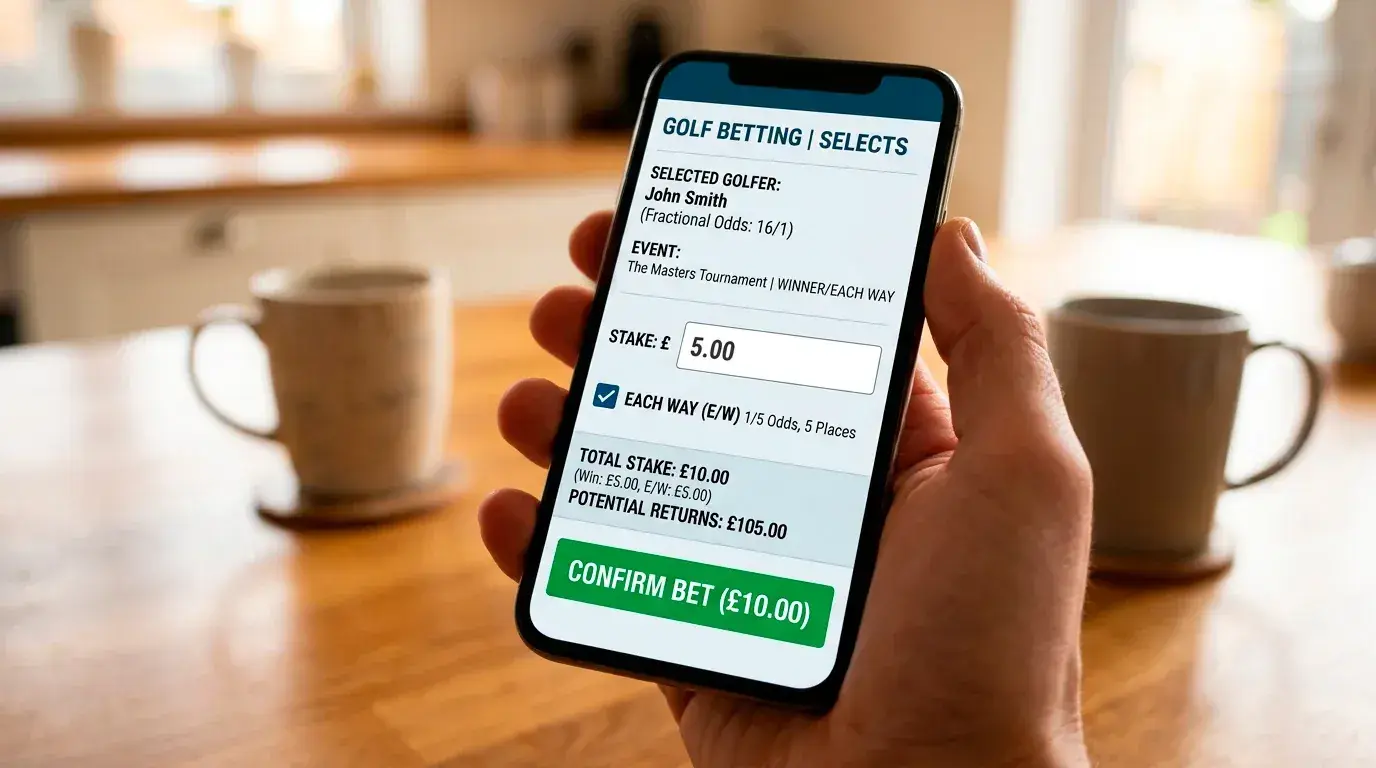
Step five: read the betslip. When you add a selection, the betslip appears (usually on the right side of the screen on desktop, or as a slide-up panel on mobile). It shows the golfer’s name, the current odds, the market type, and an input field for your stake. Look for the each-way checkbox or toggle — ticking it means you are placing two bets (win and place) at the unit stake you enter. If you enter five pounds and tick each-way, your total outlay is ten pounds. The betslip should also display the each-way terms: the place fraction and the number of paying places. Read these before confirming.
Step six: confirm. Review the selection, the stake, the total outlay and the each-way terms one final time. Then tap or click “Place Bet.” You will receive a confirmation screen showing your bet reference number. Screenshot it. If there is ever a dispute about settlement, that reference number is your proof.
After placing the bet, the tournament plays out over four days. Your operator’s app will show your active bets, updated with the current cash-out value as the tournament progresses. You do not need to do anything further unless you choose to cash out or place additional bets. For a deeper understanding of how the odds on your betslip translate into probabilities and potential returns, the golf betting odds guide covers fractional, decimal and implied probability conversions in full detail.
Reading Golf Odds Without a Maths Degree
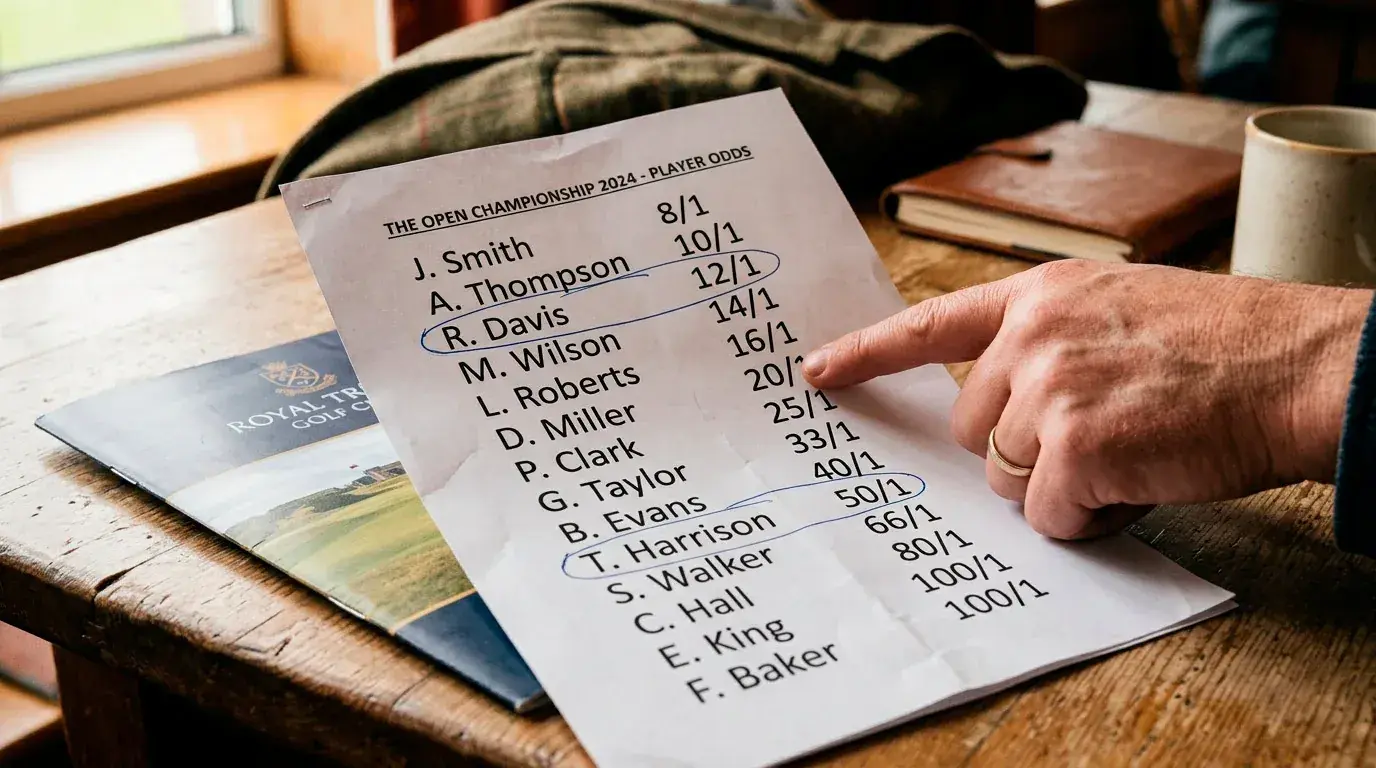
The numbers on a golf betslip look intimidating because they are unlike anything you see in football or racing at the shorter end of the board. A Premier League favourite might be 1/2. A golf favourite is 8/1 at best — and most of the field is priced at 40/1, 80/1 or longer. Those long numbers are not a mistake. They reflect the genuine improbability of any single player winning a 156-man tournament.
UK operators default to fractional odds — the format that shows the profit relative to the stake. At 40/1, you profit forty pounds for every one pound staked. At 8/1, you profit eight for every one. The number on the left is the profit, and the number on the right is the stake. Your total return is the profit plus the original stake, so a winning five-pound bet at 40/1 returns two hundred pounds in profit plus five pounds back, totalling two hundred and five pounds.
Decimal odds express the same information differently. A fractional price of 40/1 converts to decimal 41.0 (40 + 1). Decimal odds show the total return per unit staked, including the stake. A five-pound bet at decimal 41.0 returns two hundred and five pounds total. Most UK operators let you switch between fractional and decimal in the settings. I use decimal for calculations and fractional for quick comparisons, but there is no analytical advantage to either — pick whichever format your brain processes faster.
The concept that links odds to strategy is implied probability. Every set of odds implies a probability of winning. The formula for fractional odds is straightforward: for odds of A/B, the implied probability is B divided by the sum of A and B. At 40/1, that is 1 divided by 41, which equals 2.44%. At 8/1, it is 1 divided by 9, which equals 11.11%. These percentages tell you the breakeven win rate. If you back 40/1 shots consistently, you need them to win more than 2.44% of the time to make a profit over the long run.
In golf, even the tournament favourite typically implies only a 10% to 15% chance of winning. That means the sportsbook is telling you the best player in the field will lose roughly 85 to 90 times out of 100. That is not pessimism — it is the mathematical reality of a large-field individual sport. Understanding this prevents the most common beginner mistake: assuming a favourite “should” win because he is the best player. In golf, the best player usually does not win any given tournament. The maths makes this clear, and accepting it early saves you from chasing short prices that carry far more risk than their odds suggest.
First Bets Worth Trying and One to Avoid
When I advise friends who are new to golf betting, I always start with the same three recommendations — not because they are guaranteed winners, but because they teach you the most about how golf betting works while limiting your downside.
The first bet to try is an each-way single on a major championship. Majors are the best starting point for three reasons. The field is full of recognisable names you may already follow, which makes the research feel less abstract. The media coverage is extensive, so you will find previews, course breakdowns and player analysis freely available online. And most importantly, operators extend their each-way terms to eight or more places during majors, which gives your place bet a wider landing zone than any regular tour event. Pick a golfer priced between 30/1 and 60/1 whose name you recognise from broadcasts, stake two to three pounds each way (four to six pounds total outlay), and follow the tournament from Thursday through Sunday. You will learn how odds move over four days, how each-way settles, and how it feels to have money on a multi-day sporting event. Whether you win or lose, that experience is worth the four to six pounds.
The second bet to try is a head-to-head matchup. Pick any regular tour event, find the matchup market, and choose a pair where you have a view on which player is in better form. The beauty of matchups for beginners is simplicity: one player beats the other, and you get paid. No leaderboard, no cut line, no field of 156 — just two golfers over 72 holes. The odds are tight (usually close to even money), which means the payout is modest, but the learning experience is concentrated on analytical thinking rather than lottery-style hoping.

The third bet to try, once you have a week or two of experience, is a top-twenty finish at a regular tour event. This is a stepping stone between outright betting and positional analysis. The odds are shorter — usually 2/1 to 5/1 for mid-ranked players — and the probability of success is high enough that you will cash roughly one in four if your selections are reasonable. It builds the habit of thinking about where a player will finish rather than whether he will win.
The bet to avoid as a beginner is the accumulator. Accas on golf are tempting because the combined odds look enormous — five outright picks at 40/1 each produce a theoretical return in the hundreds of thousands. But the probability of all five winning is vanishingly small. Each leg compounds the risk, and in golf, where even a strong selection has a sub-5% win probability, a five-fold acca has an expected hit rate close to zero. I have been betting on golf for nine years and I have never cashed a five-fold golf accumulator. Build your understanding on singles and simple combinations before you explore accas, if you explore them at all.
Building Confidence Week by Week: A Four-Week Starter Plan
I have seen too many beginners dive into golf betting with real money on day one, lose their first three bets, and walk away convinced the game is rigged. It is not rigged — they just skipped the learning phase. Here is a four-week plan I give to every friend who asks me how to start, designed to build competence before confidence and confidence before serious stake levels.
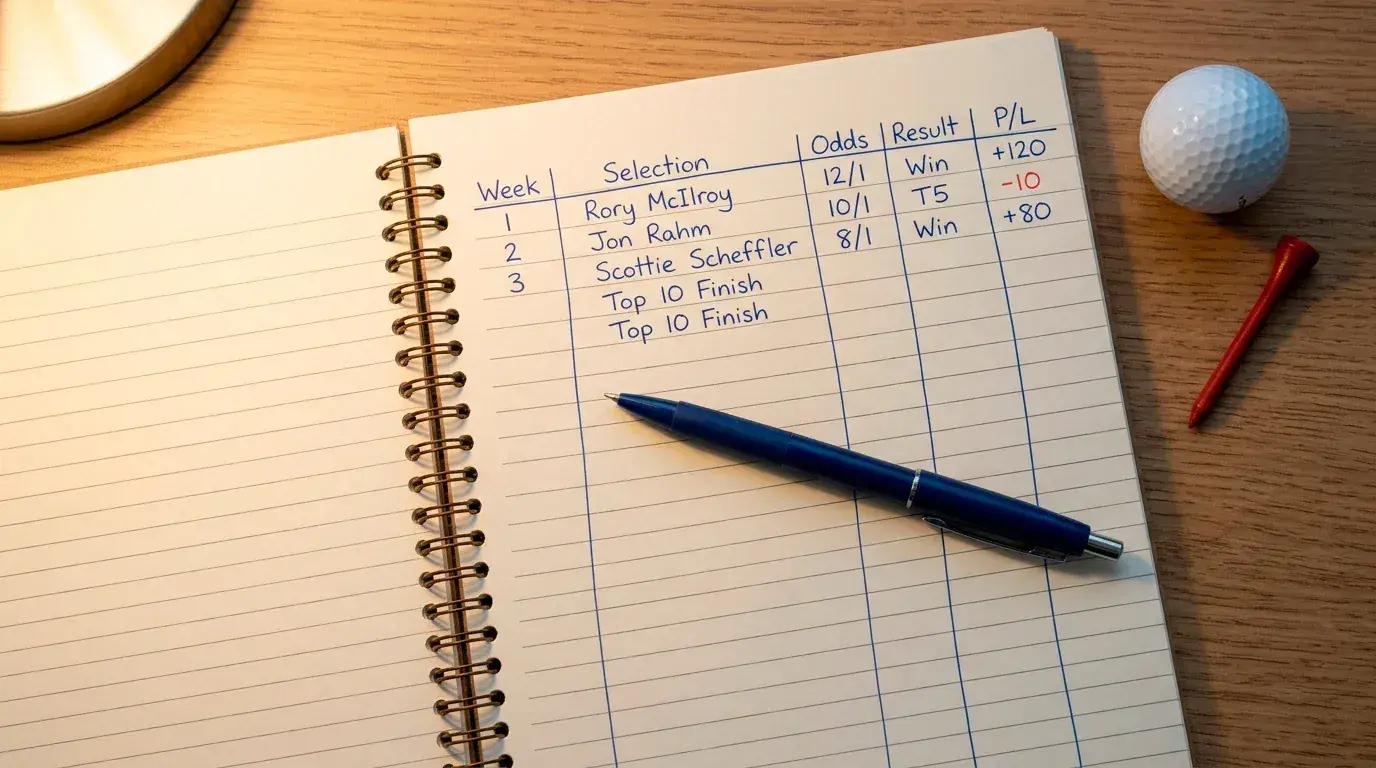
Week one is observation only. No real money. Pick a PGA Tour event, choose three golfers you think will perform well, and write down your selections with the odds available at the time. Track the tournament from Thursday through Sunday. On Sunday evening, check how your selections finished and calculate what your profit or loss would have been if you had staked five pounds each way on each one. Record everything in a simple spreadsheet or notebook: the golfer, the odds, the each-way terms, the finishing position, and the theoretical profit or loss. This exercise costs nothing and teaches you how the settlement process works, how the odds you saw on Tuesday compare to where they ended, and whether your selection instinct has any basis.
Week two introduces real money at minimum stakes. Place one each-way bet on a major or regular tour event. Keep the unit stake at two to three pounds. The goal is not profit — it is experience. You want to feel the difference between watching a tournament with money on it and watching without. Pay attention to how your emotions respond when your golfer birdies the first hole versus when he bogeys the third. That emotional awareness is the foundation of discipline.
Week three adds a second market type. Keep your each-way bet, and add a head-to-head matchup. Now you are running two different bets across the same tournament, learning how each one behaves over four days. Compare how the outright each-way bet feels (slow, uncertain, dependent on a distant finishing position) versus how the matchup feels (more immediate, more binary, more like a direct contest). That contrast will tell you which market type suits your temperament.
Week four is the review. Sit down with your records from the first three weeks. Calculate your total invested, total returned, and net result. More importantly, write down what you learned: which research helped, which emotions interfered, which market type engaged you most, and what you would do differently. This reflective step is the one most beginners skip, and it is the one that separates punters who improve from punters who repeat the same mistakes for years.
After four weeks, you have enough experience to decide how you want to proceed: increase stakes gradually, specialise in a market type, or develop a more structured research process. The key is that you have built a foundation of real experience at a cost of less than thirty pounds.
