


The Foundation Nobody Wants to Build
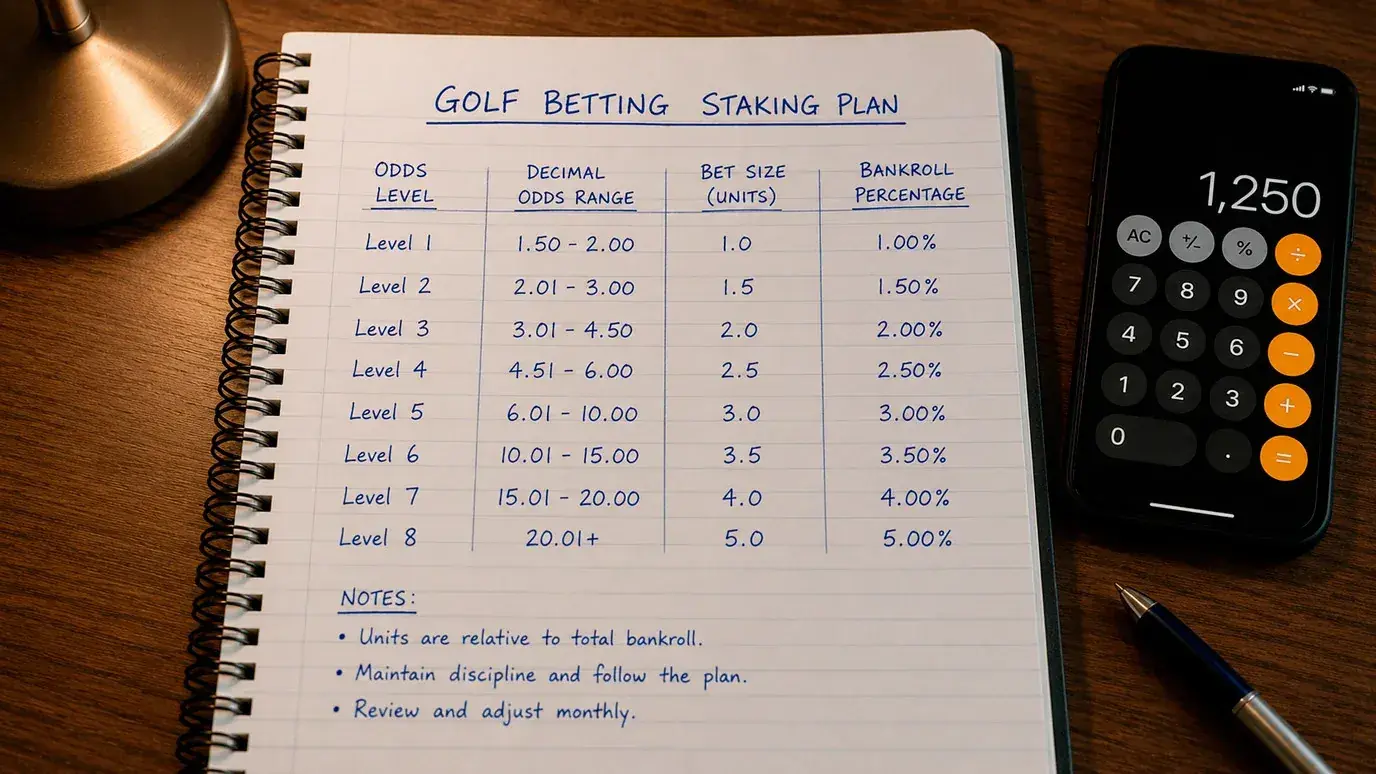
I lost 40% of my golf betting bankroll in a single month during my second year. Not because my selections were terrible — my strike rate was actually above expectation that season. I lost because I had no staking plan. I was betting GBP 50 on a 100/1 longshot and GBP 50 on a 6/1 matchup favourite, as if those two bets carried identical risk. That experience forced me to build the bankroll management framework I still use today, and it remains the single most important improvement I have ever made to my golf betting process.
The average bookmaker win rate reached a record 9.7% in 2025. That number means the structural headwind against punters has never been stiffer. Without disciplined bankroll management, even a skilled analyst with a genuine edge will eventually go bust, because golf’s inherent variance — long odds, large fields, unpredictable outcomes — produces losing streaks that can destroy an unmanaged bankroll. Bankroll management does not make you a better handicapper. It ensures that your handicapping ability survives long enough to produce results.
This article covers the staking models that work for golf’s unique probability structure, the variance realities of long-odds betting, and the review cycles that keep a bankroll healthy over a full season.
Staking Models for Golf
Golf betting sits in an unusual probability space. Unlike football, where most bets fall in the 1/1 to 5/1 range, golf outrights routinely price at 20/1 to 150/1. Matchup bets and top-finish selections offer shorter prices, but even these typically sit at 6/5 to 5/1. This wide range of odds demands a staking plan that adjusts exposure to probability.
Flat staking is the simplest approach: you wager the same fixed amount on every bet, regardless of odds or confidence level. A flat stake of 1 unit (typically 1% to 2% of your total bankroll) on every selection ensures that no single bet can cause meaningful damage. The downside is that flat staking treats all bets equally, ignoring the information asymmetry between a well-researched value bet and a speculative punt.
Proportional staking adjusts the stake based on the odds. The simplest version targets a constant potential return: if your target return is 5 units, you stake 0.25 units on a 20/1 shot and 2.5 units on a 2/1 shot. This approach normalises risk across different odds levels but can lead to disproportionately large stakes on short-priced bets, which carries its own risk if several short-priced selections lose consecutively.
The Kelly criterion is the mathematically optimal staking formula: it calculates the stake as (edge / odds), where edge is the difference between your estimated probability and the implied probability. A 5% edge on a 20/1 shot produces a Kelly stake of approximately 0.25% of bankroll. The full Kelly is aggressive — most professional bettors use quarter-Kelly or half-Kelly to reduce volatility. I use quarter-Kelly for my golf betting, which means my stakes are small but my bankroll is extraordinarily resilient to losing streaks.
My recommendation for punters starting out in golf is flat staking at 1% of bankroll per bet. It is simple, robust, and removes the temptation to overbet on “certainties” that rarely are. Once you have a 12-month track record and a clear edge measurement, graduating to a Kelly-based system is worth considering.

Variance and the Long-Odds Reality
Golf betting’s long odds create a variance profile that punters from other sports find shocking. In the UK, 2.7% of adults score eight or higher on the Problem Gambling Severity Index, representing approximately 1.4 million people. I mention this not as a moral aside but as a practical warning: golf betting’s extreme variance — long losing streaks punctuated by occasional large wins — can trigger the psychological patterns that lead to problem gambling if a punter’s bankroll management is not airtight.

IC360’s co-CEO Scott Sadin described his company’s mission as “providing world-class technology and expert services” to protect sporting integrity. Punters need to apply a similar level of rigour to protecting their own financial integrity. A golf outright bet at 40/1 has an implied probability of approximately 2.4%. If your true edge pushes that to 3.5%, you are placing a bet that loses 96.5% of the time. Over a 40-week season, placing one such bet per week, you should expect to win zero to two times and lose 38 to 40 times. The maths is clear, but the emotional experience of 20 consecutive losses is brutal, and most punters abandon their strategy long before the winning bets arrive.
I track my results in a spreadsheet that calculates my expected losing streak length at the start of each season. For my typical bet profile — a mix of outrights, top-finish, and matchup bets — the model predicts a maximum losing streak of 15 to 25 bets at least once per season. Knowing this in advance does not make the streak pleasant, but it prevents me from panicking and abandoning a strategy that is mathematically sound.

Setting Limits and Review Cycles
Every bankroll needs boundaries, and I enforce mine through a system of weekly and monthly reviews that has kept me solvent through nine years of golf betting.
My weekly limit is 10% of bankroll. If my total weekly stakes reach that threshold, I stop betting for the week regardless of remaining opportunities. This limit prevents the “one more bet” mentality that erodes bankrolls during losing streaks. My monthly loss limit is 25% of bankroll. If my cumulative monthly loss reaches this level, I pause all betting for two weeks and conduct a full review of my selection process. The pause is not punitive — it is diagnostic, designed to determine whether the losses reflect bad variance or a genuine flaw in my analysis.
Monthly reviews cover three areas: strike rate (are my selections winning at the expected rate?), average odds of winners (are my winners landing at the expected price level?), and staking discipline (did I deviate from my staking plan at any point?). If all three metrics are within expected bounds, the losses are variance, and I resume with confidence. If any metric is outside expected bounds, I investigate the cause before returning to active betting with a clear process.

Deposit limits through your bookmaker’s responsible gambling tools are a useful supplementary control. I set a monthly deposit limit on every account I use, which provides an external brake that functions even if my internal discipline falters. These limits are not a sign of weakness — they are a professional risk-management tool that every serious bettor should employ.