


Why Golf Gives You Time That Other Sports Do Not
I was sitting in a pub near Royal Liverpool during the 2023 Open Championship when a golfer I had backed ante-post at 40/1 bogeyed three of his first six holes on Thursday. His outright price drifted from 40/1 to 120/1 in under ninety minutes. By the back nine he had steadied, birdied two of the last four holes, and was back inside the top twenty. I topped up my position at 80/1, mid-round, with a live bet that I had three hours to think about. That is the structural gift golf gives in-play bettors: time.
A football match lasts ninety minutes and the ball changes possession every few seconds. A tennis point resolves in under thirty seconds. A golf round takes four and a half hours, and each player hits roughly 70 to 75 shots with minutes between each one. Between every shot, the leaderboard updates, the odds recalibrate, and you have a window to assess, analyse and decide. Live golf betting is not about reflexes — it is about patience, observation, and a willingness to act when the market overreacts to short-term noise.
The numbers support the shift toward in-play. Online betting now accounts for 78.47% of the UK sports betting market by revenue share, and a growing fraction of that online volume is placed during live events. UK online gross gaming yield grew 7% year on year in the final quarter of the 2024-2025 reporting period, reaching GBP 1.45 billion in a single quarter. Golf’s slow pace and four-day structure make it one of the sports best suited to in-play engagement, because the time between price-moving events is measured in minutes rather than seconds. That breathing room allows you to apply the same analytical framework you would use for a pre-tournament selection, but in real time, with updated information.

How In-Play Golf Odds Move Shot by Shot
Picture a leaderboard with 78 players on the course simultaneously, each one hitting a shot every three to four minutes. Every birdie, bogey, double bogey and eagle ripples through the entire outright market, adjusting not just the price of the player who hit the shot but the prices of every other player in the field. Live golf odds are a continuously recalibrating probability surface, and understanding how that surface moves is the foundation of in-play betting.
The basic mechanic is intuitive. When a player makes birdie, his outright price shortens (becomes less generous) because his probability of winning has increased. When he makes bogey, the price drifts (becomes more generous). The magnitude of the move depends on context. A birdie on the first hole of round one barely registers on a player priced at 60/1 — it might trim him to 55/1. A birdie on the 15th hole of the final round when the player is one shot off the lead can halve the price in seconds. The closer the player is to winning, the more each shot matters to the odds.
What is less intuitive is how one player’s result affects everyone else. In a leaderboard with 78 active players, a birdie from the current leader pushes every other player’s price out slightly, because the leader’s increased probability must be subtracted from somewhere. Conversely, a double bogey from the leader compresses the entire field’s prices inward. This cascading effect creates brief windows of mispricing. When the leader drops a shot, the market scrambles to reprice fifty or sixty players simultaneously. Some of those repriced players get overcorrected — their prices drift too far or not far enough — and sharp in-play bettors exploit those seconds of imbalance.
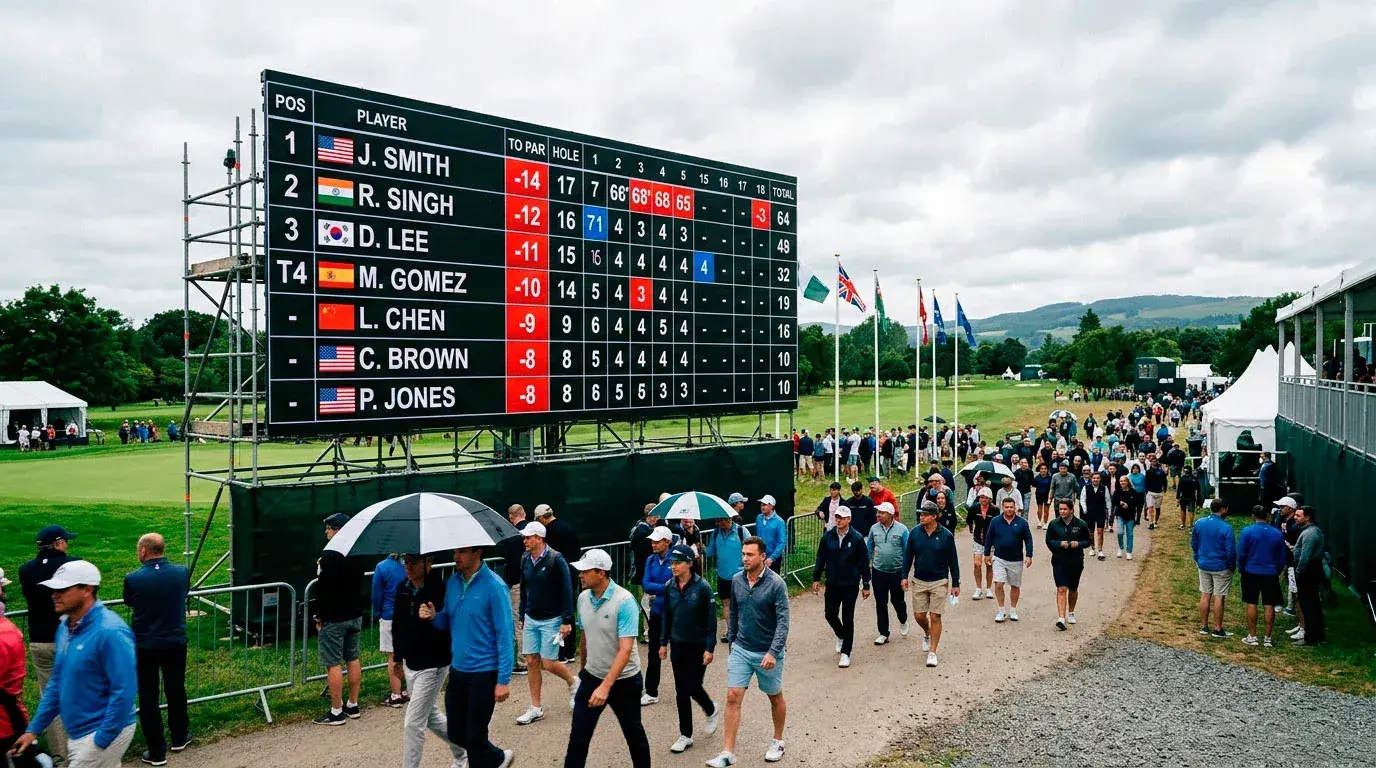
Certain parts of a golf course generate more volatile odds movement than others. At Augusta National, Amen Corner — holes 11, 12 and 13 — is the most famous pressure zone in the sport. Water on 12, risk-reward decisions on 13, and the difficulty of 11 produce scoring swings that regularly move outright prices by 30% or more in the span of three holes. At The Open, the closing stretch into the wind on a links course creates similar volatility. Knowing which holes on a given course are the highest-variance scoring holes lets you anticipate when the biggest odds movements will occur and position yourself beforehand.
Weather adds another layer. If a storm delay interrupts play and half the field has completed their rounds while the other half is mid-round, the market must price two populations differently. Players who finished before the storm locked in their scores. Players returning after the delay face softened or hardened conditions depending on the weather. Operators handle this by widening the spread on active players’ prices, which creates more room for value if you have a strong opinion on how the weather change will affect scoring. Wind shifts between morning and afternoon waves produce the same effect on a subtler scale — and at links tournaments, a two-club wind difference between waves is worth three to four strokes on average across the field.
Available In-Play Markets From Thursday Through Sunday
Not every golf market stays open once the first ball is in the air. Some shut down entirely, some evolve through the tournament, and a few only become available during live play. Knowing which markets are accessible at each stage of a four-day event is half the battle of in-play golf betting.
The outright winner market is the backbone of live golf betting and remains open from the first tee shot on Thursday through to the final putt on Sunday. Prices update continuously as scores change, with the frequency and magnitude of updates increasing as the tournament progresses. By Sunday afternoon, outright in-play prices move with every shot from the final group. In a market where UK punters place 290.03 million online wagers on real events every month, the golf outright in-play market absorbs a meaningful share during major tournament weekends.
Round matchups — head-to-head bets between two players for a single round — are specifically designed for in-play engagement. These open when the round begins and close when the last player in the matchup finishes the 18th hole. Round matchups are popular on Thursday and Friday when the tournament is still finding its shape, and they offer a faster resolution than full-tournament matchups. Some operators also offer live three-ball matchups tied to specific tee-time groupings.
Hole-by-hole markets represent the most granular level of in-play golf betting. These ask you to predict the outcome of a single hole for a specific player or group: birdie, par, bogey, or a named player to win the hole in a group. Not every operator offers hole-by-hole, and those that do typically limit it to featured groups or leaders during weekend rounds. The pace is still manageable — you have several minutes between each hole result to consider the next — but the volume of decisions can be high if you engage with every hole. For punters who enjoy the granularity, the hole-by-hole golf betting guide goes into the mechanics and strategy in detail.
Make or miss the cut is a live market that peaks on Friday afternoon, as players on the bubble play their final holes of the second round. The cut line moves as scores are posted, and the odds on individual players to make or miss the cut fluctuate accordingly. This is one of the most dynamic in-play markets because it has a fixed, imminent deadline — the cut is determined at the end of round two, and every shot over the last few holes of Friday play directly affects the outcome.

By Saturday and Sunday, the market menu narrows to outright, round matchups, some top-finish markets and occasional hole-by-hole options. The tournament’s structure drives this: with the field trimmed after the cut, the number of active betting opportunities decreases while the intensity of each remaining market increases.
Timing Your In-Play Bets for Maximum Edge
Mark Locke, the CEO of Genius Sports, noted that his company’s betting business “continues to outpace the broader industry” while media operations reach an “inflection point with accelerating momentum.” That acceleration is built on data infrastructure that feeds real-time information into the same sportsbooks where you and I place in-play wagers. The quality and speed of live data keeps improving, and the punters who profit are those who use it to time their entries rather than react emotionally to what they just watched on a broadcast.
The first timing strategy I rely on is the post-bad-start overreaction. When a well-backed favourite bogeys two of his first four holes on Thursday, the market often overreacts. His outright price might double in 45 minutes, reflecting a swing in sentiment that outpaces the actual change in his win probability. Four bad holes out of 72 is statistically minor — the equivalent of a football team conceding in the fifth minute of a match that is 90 minutes long. If my pre-tournament analysis rated the player as a genuine contender based on course fit and form, a price that has drifted 50% or more on a few early bogeys is an opportunity to add to my position at a better number than I could have accessed pre-tournament.
The second strategy involves Saturday evening, specifically the window between the end of round three and the start of round four on Sunday. By Saturday evening, the 36-hole cut has trimmed the field, the leaderboard is established, and you know the exact pairings and tee times for the final round. If an outsider is sitting in the top five heading into Sunday, the market prices him more generously than his position suggests because the collective assumption is that he will fade under pressure. That assumption is often wrong — players who reach the top five after 54 holes have demonstrated form consistency across three rounds, and statistical regression is not as severe as narrative bias implies. Sunday-morning prices on 54-hole outsiders are some of the most consistently undervalued lines in golf betting.

The third strategy is weather-driven. When mid-round weather shifts are forecasted — a wind change at 2pm, rain expected from 3pm — players on the course before the shift play in different conditions than those who face the weather. The market adjusts, but not always quickly enough. With 13.5 million active online gambling accounts in the UK as a monthly average, information travels fast through the market — but meteorological specifics like wind direction changes on specific holes still take time to be fully priced in. If you monitor weather radar during a round and compare it against the course layout, you can identify which players benefit from the timing of the shift before the broader market fully adjusts.
The unifying principle across all three strategies is patience. In-play golf betting rewards the punter who waits for the price to move to the wrong number, not the punter who chases action on every hole. My best in-play weeks have involved placing two or three bets across an entire four-day tournament. My worst weeks have been the ones where I placed fifteen.
Cash Out and Hedging: Locking Profit Before the Final Putt
In 2022 I had a 66/1 ante-post ticket on a golfer who led by three strokes going into the final round. The cash-out offer from my operator was sitting at roughly 70% of the full potential payout. I stared at my phone for twenty minutes. He could win and I would pocket the full return. He could collapse on the back nine and I would get nothing. Or I could take the 70% and walk away with guaranteed profit. I took the cash out. He won by five shots. I left money on the table — and I would make the same decision again.
Cash out is a feature offered by most UK operators that allows you to settle a bet before the event is decided, at a price determined by the current market conditions and the operator’s margin. If your selection is performing well, the cash-out value will be positive — the operator offers you a portion of the potential payout in exchange for closing the bet. If your selection is performing poorly, the cash-out value may be less than your original stake, effectively letting you recover some of your money rather than losing the full amount.
Partial cash out extends the concept by letting you settle a portion of the bet while leaving the remainder active. If the cash-out offer is GBP 200 on a bet with a potential return of GBP 300, you can take GBP 100 in cash and leave GBP 100 riding. This is useful when you want to lock in some profit but still retain exposure to the upside. The maths of partial cash out favours the operator slightly — the margin embedded in the cash-out price is typically wider than the margin on the original bet — but the risk management benefit for the punter is real.
Hedging is the manual version of cash out. Instead of accepting the operator’s offer, you place a separate bet against your original position to guarantee a profit regardless of the outcome. If you hold a 66/1 ante-post ticket on a golfer who is now 5/1 in-play, you can bet against him (or back the field) at a stake calculated to produce a guaranteed return. The advantage of hedging over cash out is that you control the price — you are trading on the live market rather than accepting the operator’s discounted offer. The disadvantage is that hedging requires a second bet, a second account if the prices differ across operators, and the mathematical discipline to calculate the correct hedge stake.
The decision framework I use is simple. If the cash-out offer exceeds 60% of the maximum potential payout and my player still has 18 or more holes to play, I take it. The remaining variance across a full round is high enough that protecting a large guaranteed profit outweighs the expected value of letting it ride. If the offer is below 40%, I let the bet run because the operator is pricing in too much residual risk. Between 40% and 60%, I evaluate the player’s current form, the course conditions, and the leaderboard compression before deciding. There is no universal right answer — it depends on your bankroll, your risk tolerance and how much the guaranteed profit means relative to the potential full return.

The Live Betting Traps That Catch Even Experienced Punters
Every in-play bettor has a Thursday-afternoon problem. The first round is underway, the leaderboard is forming, and the temptation to place a bet on every interesting price movement is overwhelming. I have been there. I once placed seven in-play bets during a single Thursday round at a tournament I barely cared about, mostly out of boredom and a vague feeling that something interesting was happening. I lost on six of the seven. That was the week I imposed a strict in-play budget and a maximum of three live bets per tournament, regardless of how compelling the action looked.
The most common live-betting trap is chasing losses mid-round. If you backed a golfer pre-tournament and he opens with a 74, the instinct is to double down at the longer price to recover. But the longer price exists for a reason — his probability of winning has genuinely decreased. Adding to a losing position because the number looks attractive is not analysis; it is averaging down without an updated thesis. I only add to an in-play position if my original pre-tournament thesis remains intact and the price has moved beyond what the performance data justifies.
Recency bias is the second trap. A player birdies three holes in a row and suddenly looks unstoppable. His price shortens dramatically, punters pile in, and the market prices him as if the birdie streak will continue indefinitely. In reality, a three-birdie run is a small sample that tells you very little about the next fifteen holes. Golf performance within a single round is only weakly autocorrelated — a great front nine does not predict a great back nine with any useful reliability. Betting on momentum in golf is betting on a feeling, not a signal.

The third trap is ignoring weather changes. A calm morning favours the early starters, and by mid-afternoon a two-club wind picks up that penalises the late wave. If you placed an in-play bet on a late starter based on morning conditions, the shift catches you off guard. I check the weather forecast three times during a live round — before the round starts, at the turn, and with nine holes remaining — to ensure my in-play positions are still grounded in the conditions the player is actually facing.
Finally, live betting on golf can become addictive in a way that pre-tournament betting does not. The slow drip of score updates across four days keeps the engagement loop running for 20 hours of live play per week. Set firm stake limits for in-play bets, treat them as a distinct bankroll category, and step away when you catch yourself betting for entertainment rather than value.
