


Assembling Your Own Market
The first golf bet builder I ever constructed looked brilliant on paper. I combined a top-20 finish for a solid ball-striker, a head-to-head matchup winner I was confident about, and a first-round-leader selection who had been starting tournaments well for months. The combined odds were enormous. The bet lost on leg one — the ball-striker withdrew after nine holes on Thursday with a wrist complaint. I had built the perfect house on a foundation I had not inspected.
Bet builders have become one of the most promoted products in UK sports betting, and golf — with its sprawling field sizes and overlapping markets — is a natural fit for the format. Outright markets account for 95% of all golf wagers in the UK, but the bet builder lets you step outside that dominance and assemble something tailored. Instead of choosing a tournament winner, you can combine a top-ten finish, a round-one matchup, and a nationality special into a single wager with a single combined price. The appeal is obvious. The traps are less visible.

This guide walks through how golf bet builders actually function, where correlation between legs creates hidden risk, and how to construct a multi-leg bet that gives you a realistic chance of collecting. For context on the underlying golf betting markets that feed into bet builders, that is a useful starting point.
How Golf Bet Builders Work
When I first started using bet builders for golf, I assumed the platform was simply multiplying my odds together — the same maths as a traditional accumulator. It took three losing months and a conversation with a former sportsbook trader to understand that the pricing is more complex, and less favourable, than straight multiplication.
A bet builder allows you to combine multiple selections from the same tournament into a single bet. The key difference from a standard accumulator — which typically combines picks from different events — is that all legs resolve within the same competition and involve players competing under the same conditions. Your top-five selection, your matchup pick, and your first-round-leader choice all play the same course in the same weather during the same week.
The platform prices the combination using a proprietary model that accounts for correlation between legs. If you select Player A for a top-five finish and also back Player A to win a head-to-head matchup against Player B, those outcomes are positively correlated — a player finishing top five is more likely to also win a matchup than a player finishing 40th. The sportsbook adjusts the combined price downward to reflect this dependency. The adjustment is not transparent: you see a final price but not the correlation factor applied to each leg.
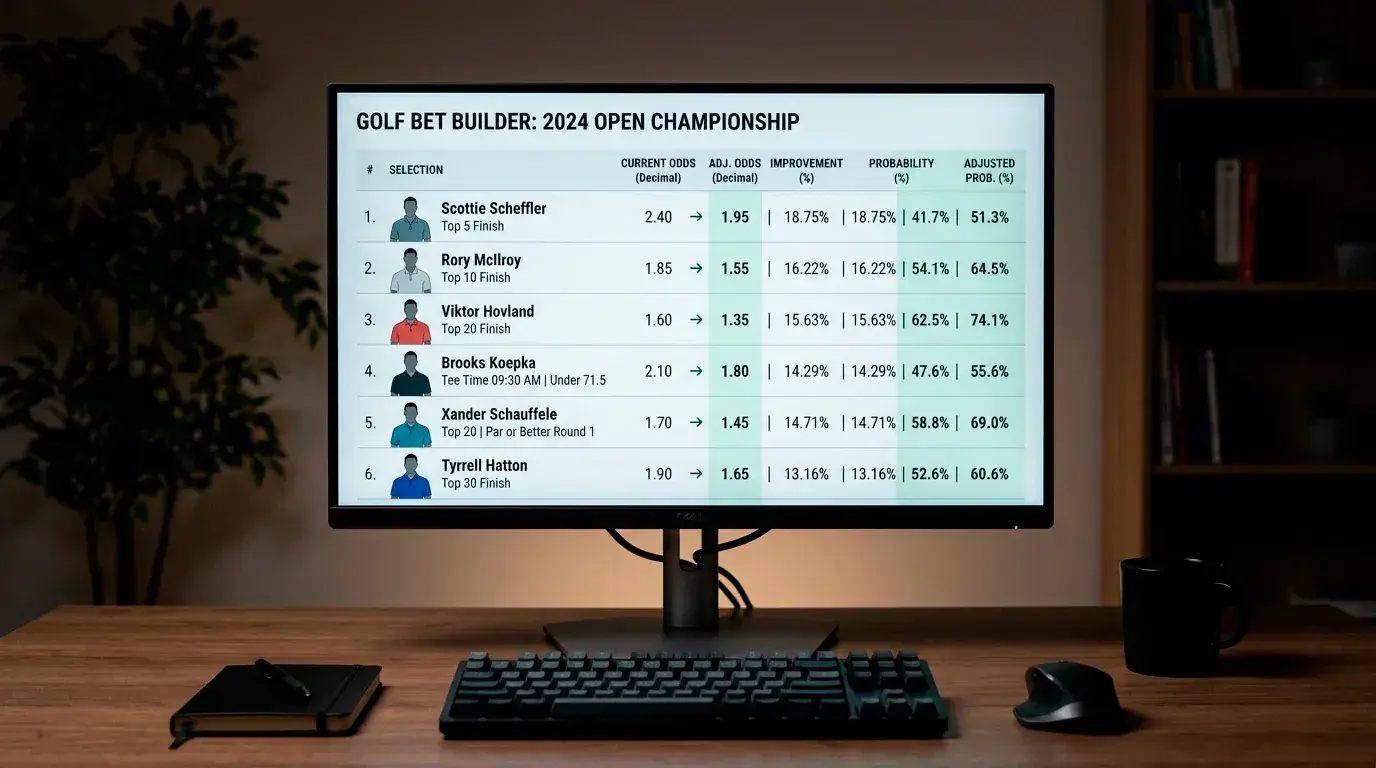
The Masters ranks as the fourth-largest single betting event globally for major operators, and during that week bet builder activity spikes dramatically. Operators promote the feature heavily because bet builders carry wider margins than individual market bets. Each leg introduces its own margin, and the combination compounds those margins multiplicatively. A four-leg bet builder where each leg carries an 8% margin effectively embeds a combined overround that is significantly higher than any single market.

Minimum and maximum stakes vary by operator and by the combination’s assessed risk. Some platforms cap golf bet builder stakes at ten or twenty pounds for high-odds combinations. Others impose minimum combined odds — refusing to build a bet if the aggregate price falls below, say, 3/1. These constraints shape what you can actually construct, not just what you might want to.
Correlation Traps in Bet Builders
Correlation is the invisible architecture of every bet builder, and in golf it runs deeper than most punters realise. I spent an entire season tracking my bet builder results against what the individual legs would have returned as separate bets, and the discrepancy was startling. The legs that won together were legs where the correlation adjustment had already compressed my price. The legs that lost together were legs where I had underestimated how linked the outcomes were.
Positive correlation is the most obvious trap. If you combine “Player A top ten” with “Player A to beat Player B in a head-to-head matchup,” the outcomes are heavily correlated. A top-ten finish almost guarantees winning most head-to-head matchups. The bet builder prices this in, but the question is whether it prices it fairly. In my experience, sportsbooks tend to under-adjust for obvious positive correlation on popular player combinations, because the resulting price is already lower than the customer expects and further compression would discourage the bet entirely.
Negative correlation is rarer in golf bet builders but does exist. If you combine “Player A to win the tournament” with “Player B first-round leader,” there is a mild negative correlation — tournaments where Player B leads after round one are slightly less likely to end with Player A winning, simply because the field dynamics shift. The sportsbook may not adjust for this at all, which can create marginal value in specific constructions.
Hidden environmental correlation catches out even experienced punters. If you combine selections from the same Thursday tee time — say, two players in the same morning group — their round-one performances are correlated through shared weather conditions. A calm morning followed by an afternoon gale will inflate morning scores and suppress afternoon ones. Your bet builder doesn’t show this, but the relationship exists and affects both legs simultaneously.

The practical defence is simple in principle and demanding in practice: build each leg independently, assess whether you would place it as a standalone bet at the implied price, and then ask whether the combination introduces correlation that compresses your edge further. If the standalone case is marginal, the bet builder version is almost certainly negative expected value.

Building a Bet Builder That Holds Up
Rather than theory, let me walk through a realistic construction process. Suppose it is Masters week. You have identified three positions you are genuinely confident about based on your pre-tournament analysis — not three players you like, but three specific market positions where you believe the available price underestimates the true probability.
Position one: a top-twenty finish for a player whose Augusta history and current Strokes Gained profile suggest a probability of around 55%, but the implied probability in the top-twenty market is only 42%. That is a standalone edge. Position two: a head-to-head matchup where your analysis of course fit gives one player a 60% chance against a 50/50 market price. Another standalone edge. Position three: over 1.5 birdies on the par fives in round one for a player with elite par-five scoring numbers. Priced at evens, you estimate 55% probability.
Individually, those three bets have positive expected value. Combined in a bet builder, you need to ask: does any correlation between them erode the aggregate edge? The top-twenty finish and the head-to-head are mildly positively correlated if the matchup opponent is outside the top twenty in your model. The par-five birdie count is largely independent of the other two legs — it resolves within round one and is driven by specific hole outcomes rather than overall tournament position.
That construction — two correlated legs and one independent leg — is a reasonable bet builder structure. The correlation adjustment on legs one and two will compress the combined price, but the independent third leg adds genuine multiplication. The resulting bet offers a combined price that, if you have done the work, still embeds net positive expected value despite the margin stack.
What makes a bad bet builder is the opposite: three or four legs that are all positively correlated, each with only marginal standalone value, combined into a headline price that feels rewarding but embeds compounded bookmaker margin on outcomes that are far less independent than they appear. Four-leg builders where every selection involves the same player are the worst offenders. The legs are maximally correlated, the margin is stacked four deep, and the player’s Thursday withdrawal wipes out everything simultaneously.