


The Allure and the Arithmetic of Golf Accumulators
I built my first golf accumulator in 2018 — three outright winners across three concurrent PGA Tour and DP World Tour events. The combined odds were astronomical, somewhere north of 200,000/1. Not one of my three selections finished inside the top 40. I laughed about it at the time, but the experience forced me to confront a truth that every golf punter must eventually accept: accumulators in golf are the most exciting and the most mathematically punishing bets available.
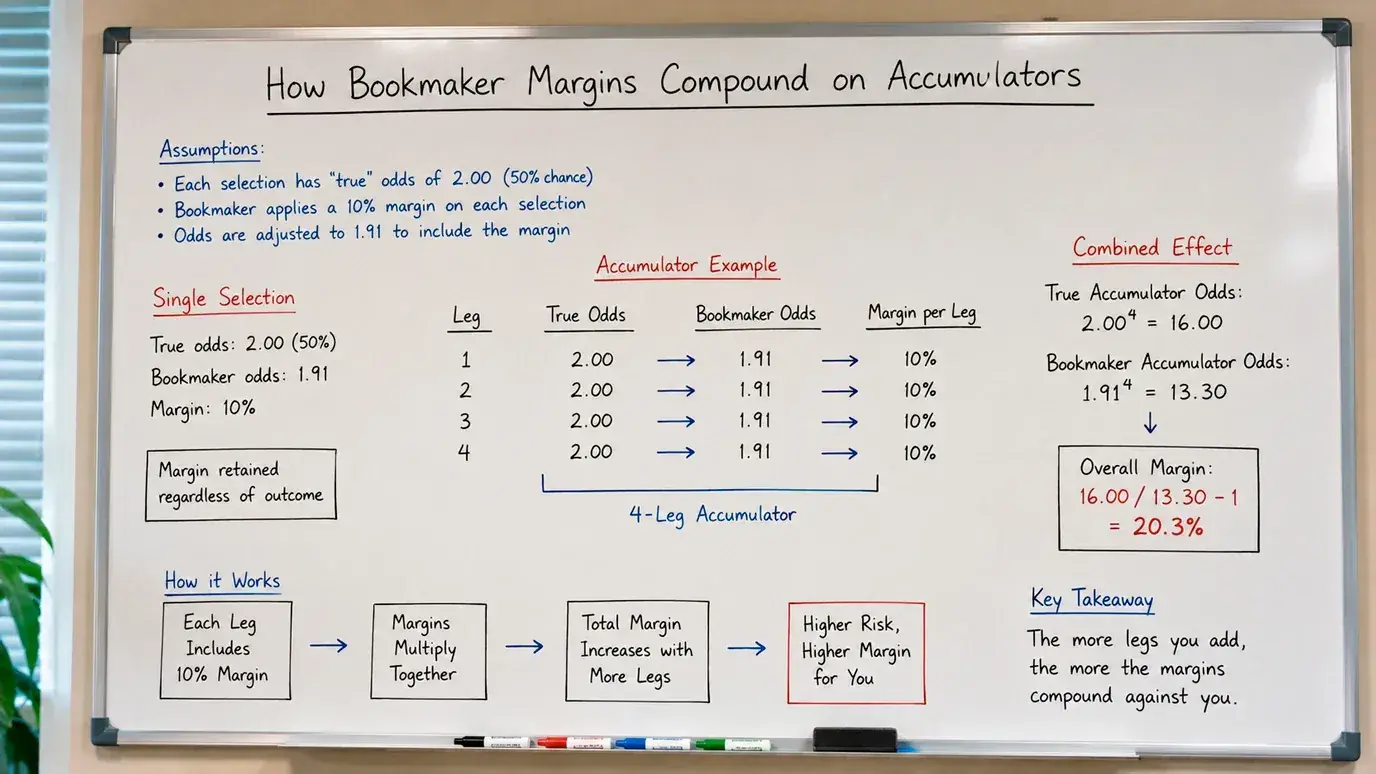
The bookmaker’s edge in sports betting has never been sharper. The average win rate for operators reached a record 9.7% in 2025, meaning that for every pound wagered, the house retains nearly ten pence before any outcomes are decided. That margin applies to single bets. In an accumulator, the margin compounds across every leg. A four-leg acca with a 10% margin on each leg does not carry a 10% disadvantage — it carries roughly 35% to 40%, because each multiplication step embeds the bookmaker’s edge again and again.
None of this means golf accumulators are irrational. They serve a purpose — entertainment, the thrill of a life-changing payout from a small stake, and occasionally a genuine expression of analytical conviction across multiple events. But approaching them without understanding the structural disadvantage is the fastest way to burn through a bankroll. This article is about building golf accas with your eyes open.
Structuring a Golf Accumulator
The first decision in any golf accumulator is which markets to combine. Since outright markets account for 95% of all UK golf betting volume, most punters default to stacking outright selections. That is the most common approach but also the highest-variance one, because each outright leg carries the lowest individual probability of success.
A more structured approach mixes market types. You might combine a top-20 finish at one tournament with a matchup winner at another and a first round leader at a third. By blending markets with different probability ranges, you create an accumulator where the individual legs have a realistic chance of landing. A three-leg acca combining a 2/1 top-20, a 6/5 matchup, and a 25/1 FRL produces combined odds around 200/1 — still a substantial payout, but with a dramatically higher landing probability than three outright winners.

Timing matters too. Golf accumulators work best when the component events are concurrent or closely spaced. Backing a player for the Masters outright, a matchup at the Heritage the following week, and an FRL at the PGA Championship a month later creates a bet that ties up your stake for weeks. I prefer accas where all legs resolve within the same Thursday-to-Sunday window, keeping capital turnover high and reducing the psychological burden of tracking a long-running multi.
The number of legs is the other critical structural choice. Every additional leg multiplies the odds but exponentially reduces the probability of a full payout. A two-leg acca retains a reasonable landing probability. A three-leg acca is speculative. Beyond four legs, you are essentially buying a lottery ticket. I cap my golf accas at three legs as an iron rule. The temptation to add a fourth “banker” leg is always there, but that banker — priced at even money — still fails 45% to 50% of the time. One failure voids the entire accumulator, and that is a mathematical reality no amount of conviction can override.

Correlation Risk in Golf Accumulators
There is a trap in golf accumulator construction that is invisible to most punters: correlated outcomes. Bookmakers price accumulator legs as if each outcome is independent, but in golf, outcomes are often linked in ways that either inflate or deflate the true combined probability.
Positive correlation occurs when the success of one leg increases the probability of another. If you back two players from the same tournament in separate top-10 bets, their outcomes are negatively correlated — if Player A finishes top 10, the remaining top-10 spots are slightly harder for Player B to claim. But if you back a player outright at one tournament and his main rival at a different tournament, the outcomes are genuinely independent, and the accumulator pricing is fair.

Weather creates another layer of correlation. If you combine two FRL bets from two tournaments being played in the same geographic region on the same Thursday, weather patterns might affect both events similarly. A freak storm disrupting one event could also disrupt the other, pushing both your selections off-track simultaneously. I mitigate this by diversifying my acca legs across different continents or at least different weather systems.

The bookmaker benefits from correlation in both directions. When legs are positively correlated (your selections are more likely to succeed together than independently), the bookmaker’s combined price is too generous. When legs are negatively correlated, the bookmaker’s price is too stingy. Understanding which direction the correlation runs in your specific acca is a level of analysis that most punters skip entirely — and it is precisely where small edges compound into meaningful long-term advantage.
What Realistic Acca Returns Actually Look Like
Let me be direct about this, because the marketing around golf accumulators creates expectations that the maths cannot support. A three-leg golf acca using outright markets has an expected hit rate of well under 1%. Over a full season of 40-plus PGA Tour events, a punter placing one three-leg outright acca per week should expect to land zero to two winners across the entire year. The payouts on those winners can be enormous — hundreds or thousands of times the stake — but the losing weeks vastly outnumber the winning ones.
The picture improves when you use mixed-market accas. A three-leg combination of top-20, matchup, and top-10 selections might carry combined odds of 30/1 to 50/1, with a landing probability of roughly 2% to 3% per week. Over a 40-week season, you might expect one or two winning accas, with each returning 30 to 50 times the stake. If your weekly stake is GBP 5, a successful season of mixed-market accas might generate GBP 150 to GBP 250 in gross returns against GBP 200 in total stakes. The margins are thin, and a single unlucky season can wipe out a year’s acca budget.

My advice to any punter considering golf accumulators is to treat them as a fixed entertainment spend, not as a profit centre. Allocate no more than 5% of your weekly golf betting budget to accas, and accept that the vast majority of that allocation will be lost. The occasional windfall is a bonus, not an expectation. The profitable core of a golf betting operation remains single-bet markets: outrights, matchups, top finishes, and each-way wagers where the compounding margin problem does not exist.
