


The Enemy in the Mirror
My worst month of golf betting was not the month I had the worst selections. It was the month I had the best selections and the worst discipline. I hit three consecutive outright winners at prices between 28/1 and 45/1, convinced myself I had cracked some fundamental code, tripled my stake sizes for the following month, and proceeded to lose more than the three winners had earned. The analysis was sound. The psychology was catastrophic.
2.7% of UK adults — approximately 1.4 million people — score 8 or higher on the Problem Gambling Severity Index, a threshold that indicates significant gambling-related harm. That statistic sits at the extreme end of a spectrum, but the cognitive biases that drive problem gambling exist in every bettor to some degree. Recency bias, confirmation bias, loss chasing, overconfidence after wins — these are not personality flaws. They are features of how human brains process risk and reward, and they affect intelligent, analytical people just as readily as impulsive ones.
This guide explores the specific cognitive biases that damage golf betting returns, practical techniques for managing emotional interference, and how to build a review process that catches psychological errors before they compound. If you have already established a bankroll management framework, this is the behavioural layer that makes it stick.
Common Cognitive Biases in Golf Betting
I keep a spreadsheet of my own betting errors — not the bets that lost, but the bets I placed for the wrong reasons. When I reviewed two years of entries, three bias categories accounted for roughly 80% of my psychological mistakes. They are the same three that I see described in every serious bettor’s post-mortem, and they are worth examining in detail because recognising them in the abstract is easy while recognising them in real time is genuinely difficult.
Recency bias is the tendency to overweight recent results at the expense of longer-term form. A player who finishes runner-up at the US Open becomes the public’s favourite for the following week’s tournament, regardless of whether the next course suits his game. The bookmakers know this and shorten the player’s price accordingly, meaning the recency-biased punter is paying an inflated price for a selection driven by one result. In golf, where week-to-week variance is enormous and a top-five finish can be followed by a missed cut with no change in underlying ability, recency bias is particularly destructive.

Confirmation bias operates more subtly. Once you have decided a player is a good bet, you selectively seek information that supports your position and unconsciously filter out information that contradicts it. You read the interview where the player says he feels great about his game. You skip the statistical breakdown showing his approach play has declined for three consecutive months. I catch myself doing this most often during major championships, where the emotional investment in a player’s story — a return from injury, a quest for a career Grand Slam — creates a narrative that feels like analysis but is actually wishful thinking.
Among 18-to-24-year-olds in the UK, 21.9% show some level of problem gambling indicators on the PGSI scale. That age group is also the most active on social media, where confirmation bias is amplified by algorithm-curated content. If you follow golf betting accounts that share your selections, your feed becomes an echo chamber that reinforces your existing positions rather than challenging them.

Loss chasing — the compulsion to increase stakes after a losing period in an attempt to recover losses quickly — is the most financially dangerous of the three. Golf’s weekly tournament cycle creates natural temptation points. You lose on Thursday and Friday, and by Saturday you are adding speculative live bets at worse prices to try to salvage the week. The maths of loss chasing are unforgiving: to recover a 10-unit loss by doubling your stakes, you need to win at exactly the same rate as before while bearing twice the variance. The probability of digging the hole deeper is substantially higher than the probability of climbing out.
Emotional Discipline Techniques
When I first tried to address my own psychological weaknesses, I made the mistake of treating it as a willpower problem. “Just be more disciplined” is about as useful as telling a golfer “just hit it straighter.” The approach that actually worked was building systems that make disciplined decisions automatic rather than effortful.
Pre-commitment is the most powerful tool I have found. Before each tournament week, I write down my selections, stake sizes, and the specific reasoning behind each bet. This happens on Tuesday or Wednesday — before any emotional attachment to Thursday’s results can form. The written plan becomes a contract with myself. If a bet is not on the pre-tournament sheet, it does not get placed. This single rule eliminates most live-betting impulse wagers and all loss-chasing behaviour, because both require in-the-moment decisions that the pre-commitment system does not allow.
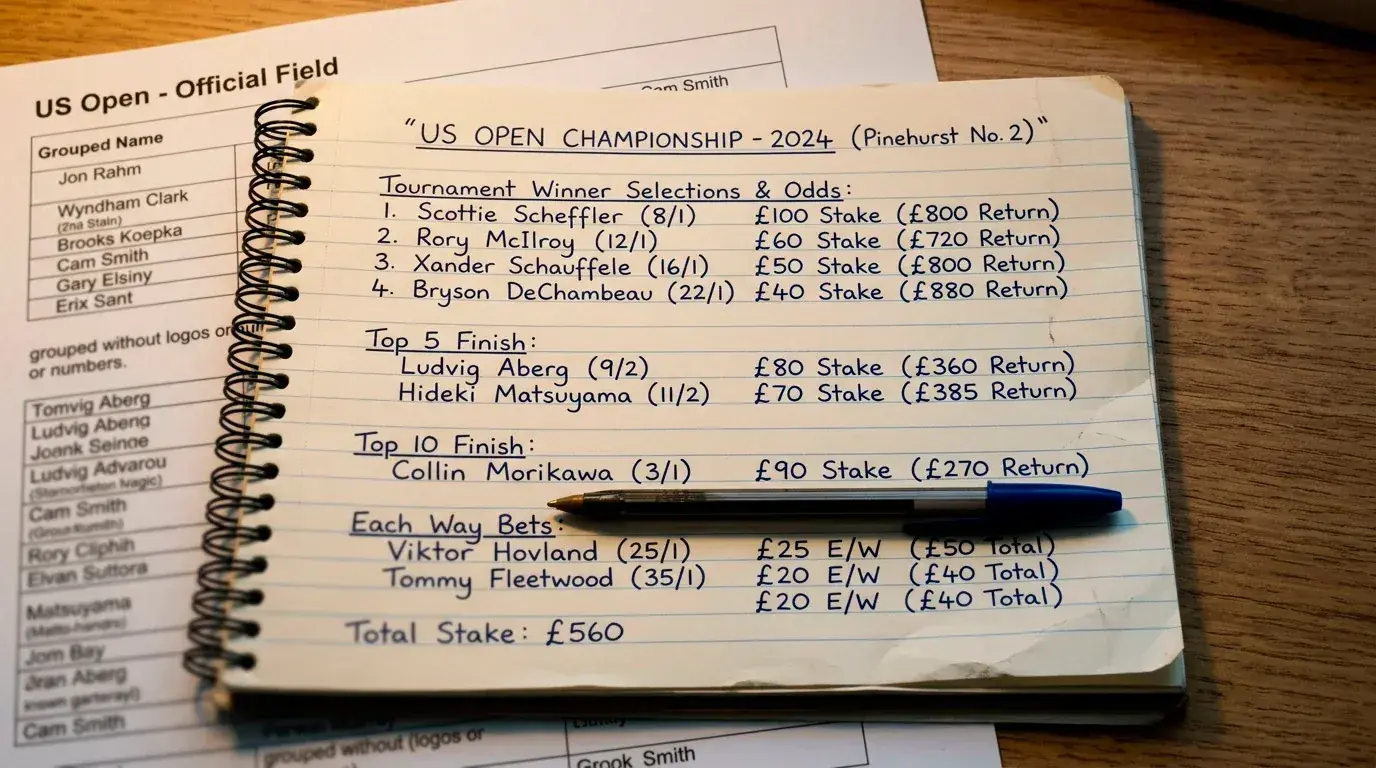
Cooling-off periods serve a similar function for bettors who are not ready for full pre-commitment. A simple rule — “no bet can be placed within 30 minutes of deciding to place it” — creates a gap between impulse and action. Most impulsive bets feel less compelling after 30 minutes of distance. The ones that still feel right after the cooling period are more likely to be analytically sound rather than emotionally driven.
Stake normalisation removes another psychological lever. If every bet is the same size — one unit — there is no opportunity for overconfidence to manifest as oversized stakes and no mechanism for loss chasing to escalate exposure. Variable staking can be mathematically optimal, but it requires a level of emotional discipline that most bettors, myself included, cannot maintain consistently. Flat staking sacrifices theoretical edge for psychological safety, and for the majority of punters that trade-off is worthwhile.
Separation of analysis and execution helps isolate the bias-prone decision points. I do my tournament research on Tuesday, finalise selections on Wednesday, and place bets on Thursday morning. The research phase is where confirmation bias is most dangerous, so I deliberately seek out reasons not to back my initial selections. If a player survives that adversarial review, the selection is stronger for it. If I cannot find counterarguments, that itself is a red flag — it usually means I have not looked hard enough.

Building a Review Process
I record every bet I place — selection, price, stake, reasoning, outcome, and a post-mortem note about whether the bet was well-reasoned regardless of result. That last field is the important one. A bet that wins at 25/1 because of a lucky bounce on the 72nd hole is not a good bet retroactively. A bet that loses because a player’s putter went cold on Sunday despite gaining strokes on approach all week is not a bad bet.
Monthly reviews separate the signal from the noise. I look at three metrics: selection accuracy (what percentage of bets would I make again with the same information?), discipline compliance (what percentage of bets matched my pre-tournament plan?), and emotional flags (how many bets were placed on impulse, during live play, or at increased stakes after a loss?). The financial return matters over quarters and years. The process metrics matter over weeks and months, and they are the leading indicators that predict future returns.
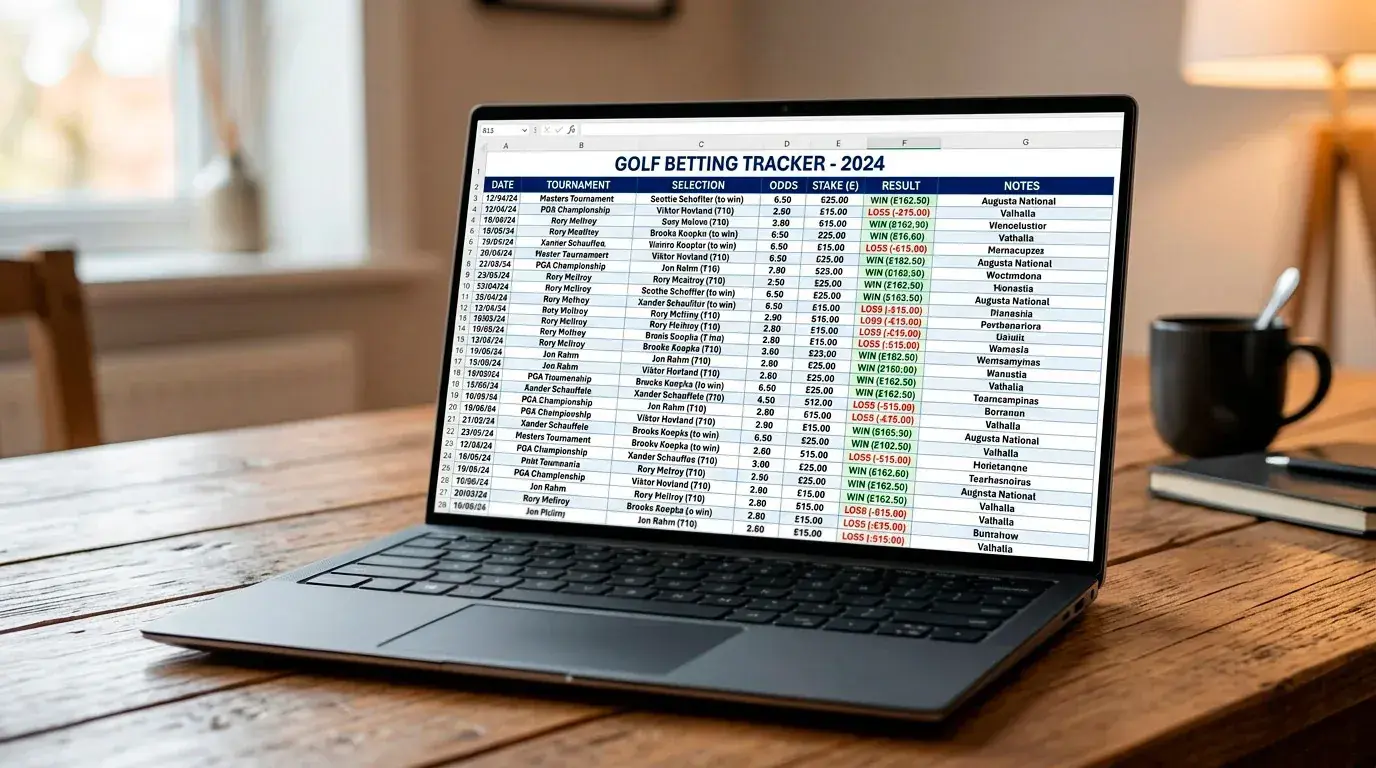
The most uncomfortable part of the review process is confronting repeated patterns. My own records show that I consistently overbet the Masters and The Open relative to their analytical merit. The emotional significance of those events — watching since childhood, attending in person, the narrative weight of major championships — biases me toward larger stakes and more selections than my models justify. Knowing this does not eliminate the bias, but it lets me apply a mechanical correction: I cap my major championship exposure at 150% of my standard weekly outlay, regardless of how many “value spots” my biased brain identifies.
Peer review adds an external check that self-review cannot provide. If you have a trusted friend or fellow punter whose judgment you respect, sharing your pre-tournament selections for critique before placing them is extraordinarily valuable. Not because they will spot analytical errors — they might not have your statistical knowledge — but because they will ask the question you are avoiding: “Are you sure about this, or do you just want it to be true?”