


Why Outright Markets Dominate Golf Wagering
I placed my first golf outright bet in 2017 — a tenner on a 66/1 shot at the Honda Classic who missed the cut by six strokes. That loss taught me more about this market than any guide ever could. Nine years later, outright betting remains the beating heart of golf wagering, and understanding how it works is the single most important skill a golf punter can develop.
The numbers tell the story plainly. Outright markets account for 95% of all golf betting volume in the United Kingdom, dwarfing every other market type combined. That concentration exists for a reason: tournament winner bets are the purest expression of golf analysis. You study the field, assess the course, evaluate form, and back a player to beat everyone else over 72 holes. There is no halfway measure, no reduced-field shortcut — just you against a field of 120 to 156 professionals.

What makes golf outright betting so different from backing a football team or picking a horse is the sheer size of the field. In a Premier League match, you have three outcomes. In a 30-runner horse race, the maths is already complex. In a full-field PGA Tour event, you are selecting one winner from a pool where even the tournament favourite rarely drops below 8/1. That structural reality shapes everything — from the way bookmakers price their markets to the way sharp punters find value. And once you grasp the mechanics behind those prices, you stop being the punter who blindly backs names and start being the one who exploits inefficiencies.
How Outright Golf Prices Are Formed
Most punters see odds on a screen and treat them as fact. I used to do the same until I spent time understanding how those numbers get built. Golf outright pricing is a multi-layered process, and it differs meaningfully from fixed-outcome sports.
A bookmaker’s trading team begins by assigning each player in the field an estimated probability of winning. They use a blend of data inputs: world ranking, recent form measured over the last 8 to 12 tournaments, course history, Strokes Gained profiles matched against course demands, and the overall field strength. These raw probabilities are then adjusted to include the bookmaker’s margin — the overround — which guarantees the operator a theoretical profit regardless of the outcome.
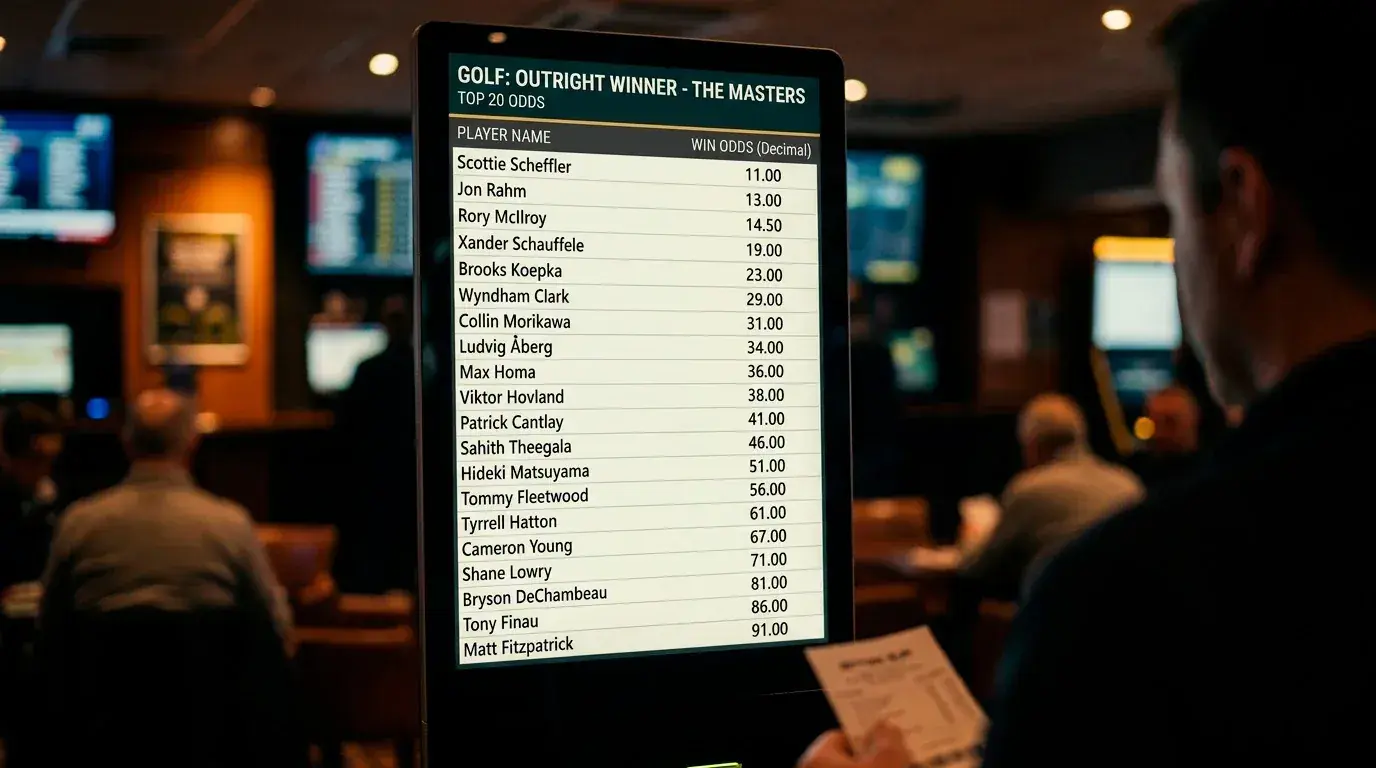
Here is where golf gets interesting. In a football match with three outcomes, the overround might sit at 105% to 110%. In a golf outright market with 150 or more runners, the overround can balloon to 140% or even higher. That wider margin means the bookmaker embeds more “fat” into every price. For the punter, this is both a challenge and an opportunity. The challenge is obvious — you are paying a steeper tax on every bet. The opportunity is that in such a large and complex market, pricing errors are inevitable. Traders cannot model every interaction between player skill, course fit, and field dynamics with perfect precision.
Consider the volume disparity across tours. PGA Tour events generate betting volumes roughly 100 times greater than LIV Golf events. That gap is not just about fan interest — it reflects the depth of data available, the liquidity of the market, and the confidence traders have in their models. When a market is liquid and well-modelled, prices are tighter and harder to beat. When it is thin, as with smaller DP World Tour events or early-season fields, the models are less certain, and prices can drift further from true probability. That drift is where educated punters find their golf betting markets edge.

I have found over years of tracking my own bets that the single biggest pricing inefficiency in golf outright markets is the undervaluation of course fit. Traders weight recent form heavily because it is the most visible input. But a player whose Strokes Gained: Approach numbers perfectly match a course’s demands can be underpriced by several percentage points, even if his recent results look mediocre on paper.
Ante-Post Pricing Versus Day-of Odds
A few years ago, I backed a player at 80/1 ante-post for the Masters — six weeks before the tournament. By Tuesday of Masters week, he had shortened to 40/1. I did nothing special. I simply identified value early, before the market priced in a strong practice-round buzz. That experience crystallised a principle I now follow religiously: in golf outright betting, when you bet matters almost as much as who you bet on.

Ante-post odds are released days, weeks, or sometimes months before a tournament. They carry wider margins because the bookmaker must account for uncertainty — player withdrawals, injuries, late field additions, and the absence of weather data. In return for accepting that uncertainty, punters get longer prices. Day-of odds, by contrast, are tighter because the known variables have been resolved: the field is confirmed, tee times are set, and weather forecasts are available.
The key trade-off is clear. Ante-post bets offer better prices but carry the risk of losing your stake if a player withdraws (most bookmakers treat ante-post as non-refundable unless the event itself is cancelled). Day-of bets reduce that risk but offer shorter odds. In practical terms, I split my outright activity roughly 60/40 in favour of ante-post, because over a full season the price advantage compensates for the occasional dead-money loss on a withdrawal. Lewis Knowles, a spokesperson for Betway, highlighted how early market interest shapes pricing during the 2026 Masters build-up: Bryson DeChambeau attracted 16% of all outright bets placed at that operator, more than any other player in the field. That kind of lopsided public money compresses a player’s price and pushes value elsewhere — a dynamic I exploit by looking at where the crowd is not betting rather than where it is.
Timing also matters within tournament week. Odds shorten noticeably between Monday and Thursday morning as information crystallises. If your research is done early, placing a Tuesday bet on a player whose price has not yet absorbed the market’s full awareness of course fit or weather advantage is a proven approach. I track these movements in a spreadsheet and have found an average of 15% to 20% price erosion between early-week and first-tee prices for players who ultimately contend.

Field Size and Its Effect on Outright Value
Something I explain to every new golf punter I mentor: the number of players in a field is not just a background detail. It is the single most important structural variable in outright golf betting. A 156-player field at a PGA Tour signature event is a fundamentally different betting proposition from a 48-player LIV Golf event or a 72-player invitational.
Larger fields produce longer odds across the board. When 156 players tee off, the favourite might sit at 10/1 or 12/1. In a 48-player field, that same calibre of favourite could be priced at 5/1. The implied probability shifts dramatically. A 10/1 price implies a 9.1% chance of winning; a 5/1 price implies 16.7%. For the punter, this means that large-field events naturally offer more each-way value, because the gap between the favourite and mid-tier contenders is wider, and place payouts become more generous relative to stake.

But field size also affects variance. In a large field, more things can go wrong. A no-name player can shoot a 62 on Thursday and scramble the leaderboard entirely. In a smaller field, form tends to hold more reliably because the overall quality threshold is higher and there are fewer random disruptors. I have seen this pattern play out repeatedly: my outright strike rate on smaller-field events sits around 3.5% over nine years, compared to roughly 1.8% on full-field PGA Tour events. The trade-off is that the prices on smaller fields are shorter, so the returns per winning bet are lower.
For punters deciding where to focus, the decision comes down to risk appetite and bankroll. If you prefer frequent small wins, smaller fields and shorter prices suit your profile. If you are comfortable with long losing runs in exchange for occasional large payouts, full-field events on the PGA Tour and majors are where the value lies. There is no objectively correct answer — only the one that matches your staking plan and psychological tolerance for variance. Either way, understanding the mechanical relationship between field size and price is what separates informed punters from those who just pick a name and hope.
