
Why Each-Way Changes Everything in a 156-Player Field
I placed my first each-way bet on a 66/1 outsider at the 2018 Open Championship. He finished tied for sixth, missed the win by a mile — and I still walked away with a return north of 13 times my place stake. That was the moment I stopped treating each way betting golf as a consolation prize and started treating it as a strategy in its own right.
In a sport where 156 players tee off and only one lifts the trophy, the maths of an outright wager is brutal. Outright markets account for 95% of all golf betting volume in the UK, yet the implied probability of any single player winning a full-field PGA Tour event rarely climbs above 15%, even for the pre-tournament favourite. Most punters accept those odds because the payouts look spectacular on a betslip. What they overlook is the place component sitting right next to the win line — a second bet, running in parallel, that pays out if your selection finishes anywhere inside the place terms.
Each-way betting splits your total stake into two equal halves. One half backs the golfer to win outright, at the full advertised price. The other half backs the same golfer to finish inside a set number of places — typically the top five or top eight, depending on the field size and the operator’s terms — at a fraction of those odds. That fraction is usually one quarter or one fifth. It sounds like a small adjustment, but over the arc of a golf season it transforms the probability curve. You no longer need your player to beat 155 others. You need them to beat most of them.
Golf ranks as the third most popular sport for betting in the UK, with 15% of active bettors placing wagers on it regularly. Those punters are not all chasing outright jackpots. A significant and growing portion have figured out what I learned at Carnoustie in 2018: in a sport this volatile, covering the place is not playing it safe — it is playing it smart. This guide walks through the mechanics, the maths and the situational logic behind each-way golf betting so you can decide when it serves your bankroll and when it does not.
The Anatomy of an Each-Way Bet
A mate of mine once placed what he thought was a tenner on Collin Morikawa to win the PGA Championship. When the debit notification showed twenty quid, he panicked and called his bookmaker. The customer service agent patiently explained that he had ticked the “each-way” box, which doubled his unit stake. That confusion is more common than the industry admits, and it starts with not understanding what each-way actually means at the mechanical level.
An each-way bet is two separate bets bundled under a single selection. The first is the win bet. The second is the place bet. If you stake “ten pounds each way,” you are committing ten pounds on the win and ten pounds on the place, for a total outlay of twenty pounds. The betslip usually shows the unit stake — in this case ten pounds — because it assumes you understand the doubling. Many beginners do not, and it catches them off guard when their bank balance drops by twice the figure they expected.
The win part behaves exactly like an outright bet. If your golfer finishes first, this half of your wager is settled at the full advertised odds. A selection priced at 40/1 returns forty times your win stake, plus the stake itself. On ten pounds, that is four hundred pounds in profit from the win component alone.
The place part is where each-way earns its reputation. This half of the bet is settled at a fraction of the full odds, but it pays out across a wider band of finishing positions. The fraction and the number of paying places vary by tournament and operator, but the standard for a full-field golf event is one fifth of the odds for the first five places. Some operators offer one quarter of the odds for five places, while others stretch to eight places at one fifth — that difference matters enormously once you start running the numbers.
Take the same 40/1 selection with terms of one fifth the odds, five places. The place odds become 8/1 (40 divided by 5). If your golfer finishes anywhere from first to fifth, the place part returns eight times your place stake, plus the stake back. On ten pounds, that is eighty pounds in place profit. If the golfer also wins, you collect both: four hundred from the win part and eighty from the place part, totalling four hundred and eighty pounds profit on a twenty-pound total outlay.
Now suppose the golfer finishes third — inside the places but not the winner. The win part loses entirely, costing you ten pounds. The place part wins, returning eighty pounds plus your ten-pound stake. Net profit: eighty pounds minus the ten-pound loss on the win part, giving you seventy pounds in the green. That is the structural advantage of each-way betting in golf. You can lose the win component and still book a meaningful profit, provided your selection lands inside the terms.
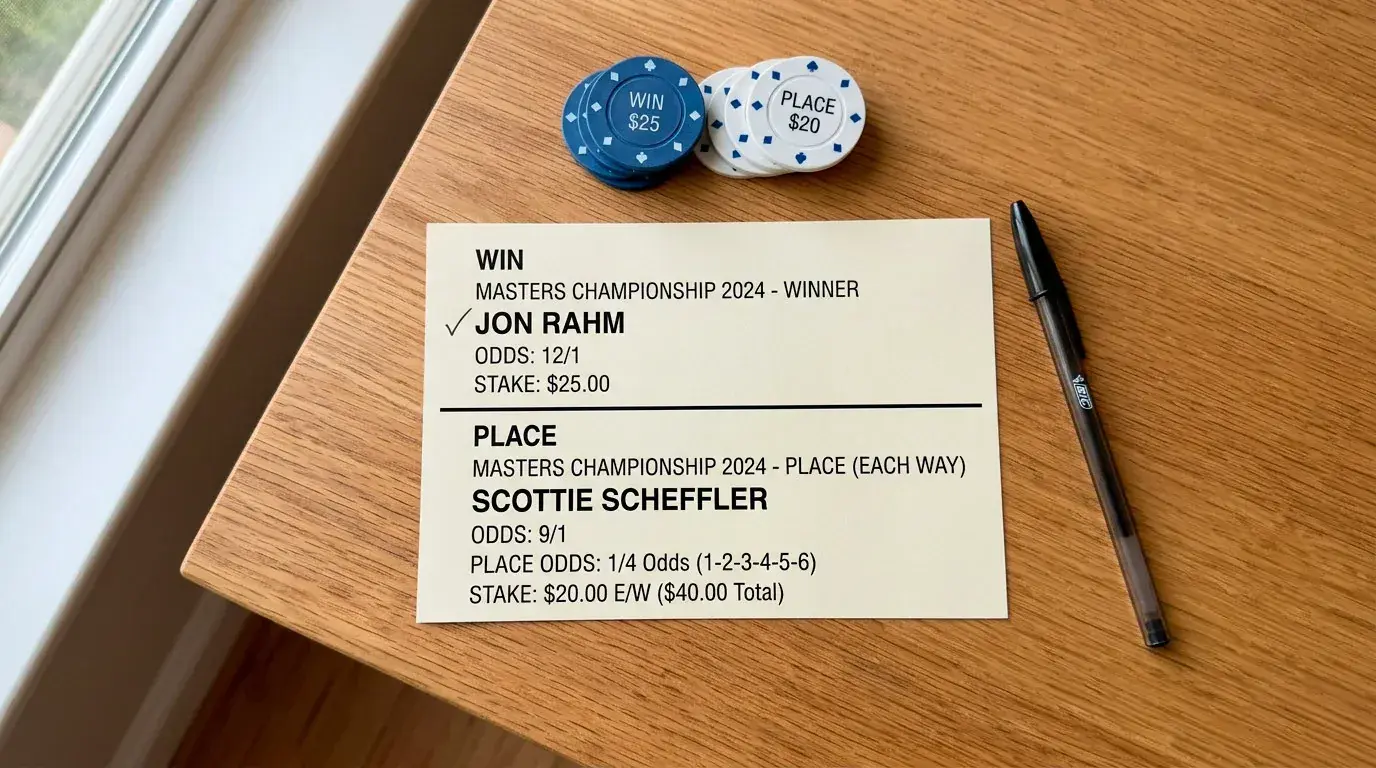
One detail that trips up even experienced punters is the “including ties” clause. If your player ties for fifth and the place terms pay five places, some operators settle at full place odds. Others apply dead heat rules, which reduce the place payout proportionally to the number of players sharing that position. I will unpack the dead heat maths later, but the key point is this: always check whether the terms read “top 5 places” or “top 5 finishing positions,” because the distinction determines whether ties help you or hurt you.
Standard Place Terms Across Field Sizes
The first question I get from punters new to golf each-way betting is always the same: “How many places does it pay?” The answer depends on the size of the field, and the relationship is not always intuitive.
For a standard full-field PGA Tour or DP World Tour event — 144 to 156 starters — the default each-way terms from most UK operators are five places at one fifth of the odds. That has been the industry baseline for decades, and it holds true across roughly 80% of weekly tour events. Some operators use five places at one quarter of the odds as a standing offer, which is a better deal for the punter because the place fraction is larger. On a 40/1 selection, one quarter gives you place odds of 10/1 instead of 8/1 at one fifth. Over a full season of each-way betting, that fractional upgrade compounds into a measurable bankroll difference.

When the field shrinks, the place terms shrink with it. Invitation events or limited-field tournaments with 60 to 80 starters typically pay three places instead of five. The Sentry, which opens the PGA Tour calendar with a field of around 60 players, is a good example — operators cut the places to three at one fifth, reflecting the smaller pool of finishers. Go below 30 runners, which occasionally happens in wind-affected events where the cut has already trimmed the field, and some operators drop to two places or suspend each-way terms altogether.
The logic behind this scaling is straightforward. Place terms exist because the probability of finishing inside a given number of positions changes with the field size. Five places out of 156 starters represents roughly 3.2% of the field. Five places out of 60 starters jumps to 8.3%. Operators adjust the terms to keep their margin stable. If they paid five places on a 60-player field at the same fraction, the expected payout on the place component would exceed what the overround is designed to absorb.
Where this gets interesting is the comparison between one fifth odds and one quarter odds. The fraction determines how much of the full price you receive on the place component. At one fifth, you receive 20% of the win odds. At one quarter, you receive 25%. On shorter-priced players — say a 12/1 selection — the difference is modest: place odds of 2.4/1 versus 3/1. On long-priced outsiders at 80/1, one quarter gives you place odds of 20/1 compared to 16/1 at one fifth. That gap of four points on the place odds, multiplied across multiple bets, is where experienced each-way punters generate their edge.
I keep a simple rule in my own betting: always check the terms before the price. A golfer at 50/1 with one quarter the odds for five places is a better each-way proposition than the same golfer at 55/1 with one fifth the odds for four places. The headline number flatters the second option, but the place component — which is where each-way bets actually survive — favours the first.
Extended Places at Majors and How They Shift Value
Pamela Maldonado, a sports betting analyst at ESPN, put it well when she described golf betting as “a slow-burn panic” where “the sharper approach is building a card with intention and direction.” Nowhere does that intentional approach pay off more visibly than during the four major championships, when UK operators roll out extended place terms that fundamentally change each-way maths.
The standard weekly terms — five places, one fifth the odds — serve as the baseline. At the Masters, the PGA Championship, the US Open and the Open Championship, most operators expand to eight paying places, sometimes ten, and occasionally twelve during promotional pushes. The fraction usually stays at one fifth, though a few operators bump to one quarter for the first named each-way places. This expansion does not happen out of generosity. The Masters alone generates 40% of all betting activity across the four golf majors, and those four events collectively account for roughly a third of the entire year’s golf wagering volume. Operators extend places because the sheer scale of handle during major week justifies slimmer margins on the place component in exchange for vastly higher turnover.
The impact on expected value is significant. In a 156-player field, standard five-place terms give your golfer a baseline probability of roughly 3.2% for a place finish, before adjusting for ability. Extending to eight places lifts that raw baseline to about 5.1%. Twelve places takes it to 7.7%. These are crude field-share figures and do not account for form, course fit or market pricing — but they illustrate the structural shift. Your place bet is covering more territory without costing any additional stake.
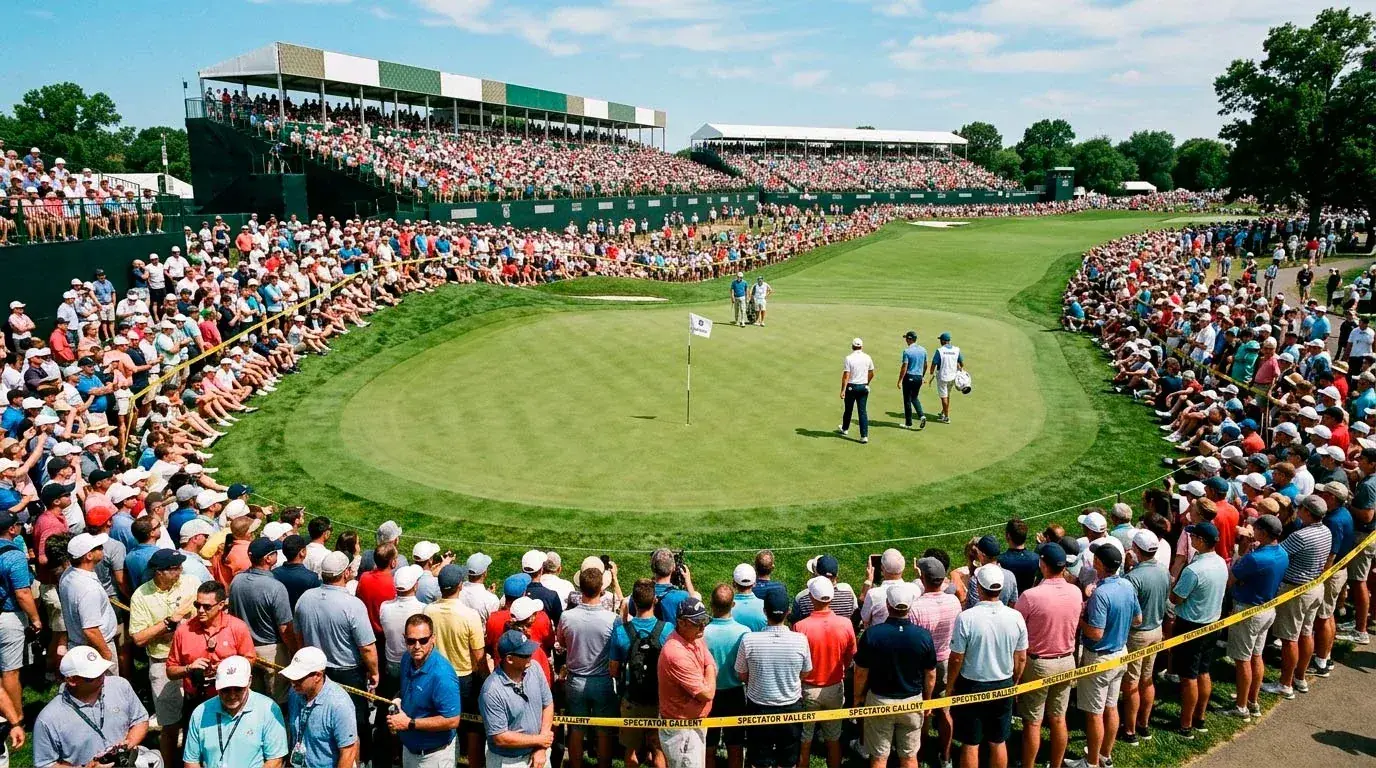
There is a subtlety that many punters miss. Extended places do not just improve the probability of the place bet landing — they alter which golfers become attractive each-way selections. Under standard five-place terms, the ideal each-way candidate is a player with strong enough form to contend for the top five but priced long enough that the win component carries real upside. At eight or ten places, the net widens. A solid but unspectacular mid-field player priced at 80/1 becomes a viable each-way play because the place component only needs a top-eight finish. The strategy shifts from picking potential winners to picking players who will survive four rounds at a high level — and in majors, where course difficulty thins the field naturally, that is a subtly different skill.
I make it a rule to plan my major each-way strategy at least a week before the tournament begins, specifically because extended terms open up selections I would never consider during a regular tour week. If you want to go deeper into how operator place terms vary across different events and how to compare them, the detailed breakdown in our guide to golf each-way places covers the full landscape.
Payout Calculations Step by Step
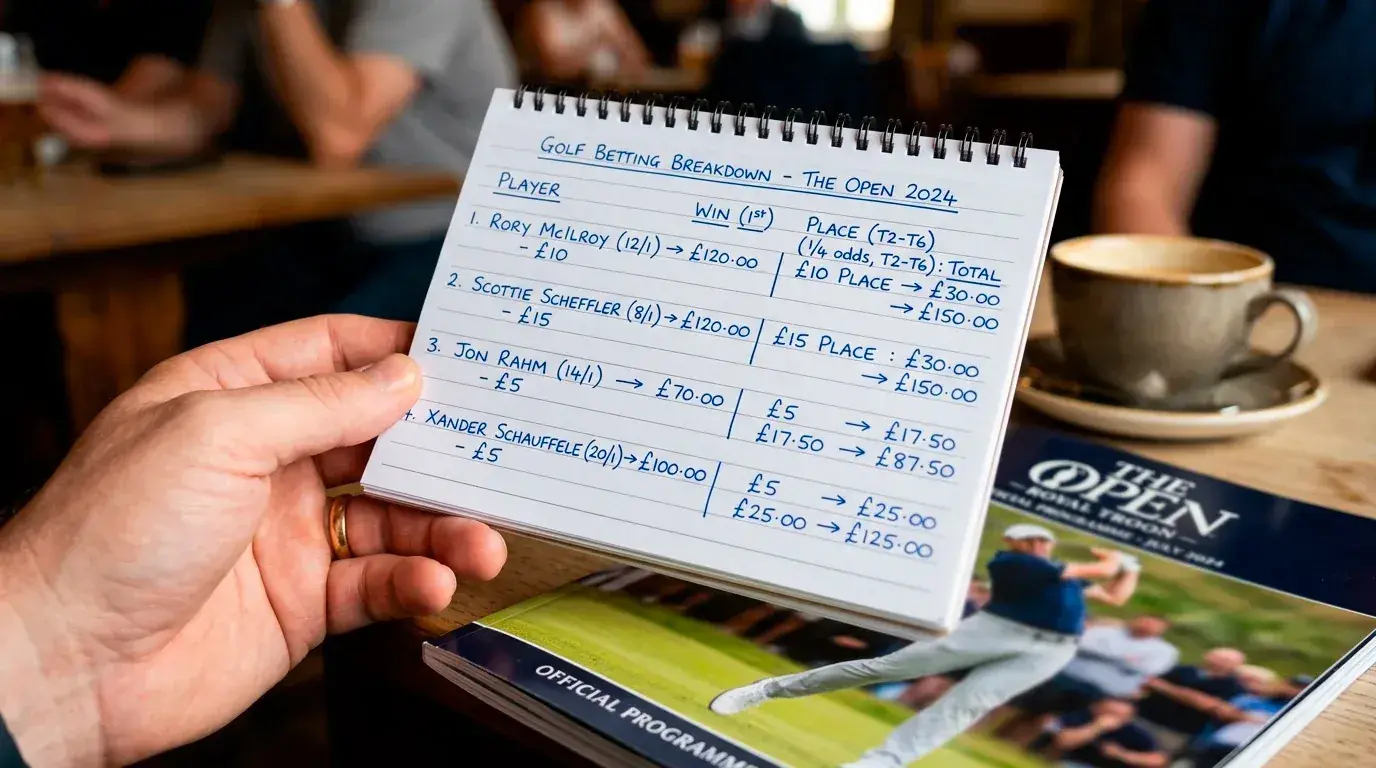
Numbers on a page never convinced me of anything until I ran them myself. I am going to walk through three scenarios with the same starting bet so you can see exactly how the money moves. The selection: a golfer priced at 33/1 in a full-field event. Terms: one fifth the odds, five places. Stake: ten pounds each way, which means a total outlay of twenty pounds — ten on the win, ten on the place.
Scenario One: Your Golfer Wins the Tournament
Both parts of your bet settle as winners. The win component pays at the full 33/1. That is ten pounds multiplied by 33, equalling three hundred and thirty pounds in profit, plus your ten-pound win stake returned — three hundred and forty pounds from the win part. The place component also wins, because the tournament winner automatically finishes inside the paying places. The place odds are one fifth of 33/1, which is 33 divided by 5, giving 6.6/1. Ten pounds at 6.6/1 returns sixty-six pounds in profit plus your ten-pound place stake back — seventy-six pounds from the place part. Your total return is three hundred and forty plus seventy-six, equalling four hundred and sixteen pounds. Subtract the twenty-pound total stake and your net profit is three hundred and ninety-six pounds.
Scenario Two: Your Golfer Finishes Fourth
Fourth place falls inside the five paying places, so the place component settles as a winner. The win component loses entirely — your golfer did not win the tournament, so you forfeit the ten-pound win stake. The place part, however, pays at the calculated place odds of 6.6/1. That returns sixty-six pounds in profit plus your ten-pound place stake, totalling seventy-six pounds from the place component. Your total return is seventy-six pounds. Deduct the full twenty-pound outlay and you net fifty-six pounds in profit. You backed a player at 33/1 who did not win, and you still made nearly three times your total stake back.
Scenario Three: Your Golfer Finishes Twelfth
Twelfth is outside the five paying places. Both the win bet and the place bet lose. Your return is zero and you lose the full twenty-pound stake. There is no partial refund, no consolation — each-way is binary within each component. Either the win lands or it does not. Either the place lands or it does not. This scenario is the one most punters experience most often, which is exactly why selection discipline matters so much. Each-way does not eliminate losing; it widens the path to winning.
The Dead Heat Wrinkle
Suppose your golfer ties for fifth place with two other players in a five-place each-way market. Three golfers share one paying position. Dead heat rules divide the place payout by the number of players sharing that position. Your place odds are still 6.6/1, but the settlement treats your bet as if only one third of your place stake was active. So instead of returning seventy-six pounds from the place component, you receive one third of the profit — twenty-two pounds in profit — plus one third of the place stake returned (roughly three pounds and thirty-three pence). The rest of your place stake is lost. Dead heats erode returns in a way that is easy to underestimate, especially in top-five markets where multiple players frequently tie around the fifth and sixth positions. My records show dead heats affect roughly one in every eight each-way golf bets that land inside the places — not rare enough to ignore.
Each-Way Versus Outright: When to Choose Which
Last season I tracked every outright and each-way bet I placed across forty PGA Tour events. The outright bets won bigger when they hit, obviously — but they hit once. The each-way bets produced smaller individual returns but cashed nine times through place finishes alone. Over the full season, the each-way portfolio returned 14% more total profit on a smaller overall drawdown. That is one season and one bettor’s sample, not a universal law — but it reflects a pattern that shows up across every serious golf betting dataset I have studied.
The decision between each-way and outright is not about preference. It is about where your selection sits on the odds board and how that interacts with the place terms on offer. At the short end of the market — selections priced around 10/1 or below — each-way rarely makes sense. A golfer at 8/1 with one fifth the odds gives you place odds of just 1.6/1. If that player finishes third rather than first, your place return barely covers the combined twenty-pound outlay on a ten-pound each-way stake. You have doubled your risk for a place payout that is essentially a breakeven. At those prices, backing outright with a single stake is more capital-efficient.
The crossover point, in my experience, sits somewhere around 20/1 to 25/1. At 25/1 with one fifth the odds, the place part pays 5/1 — enough to deliver a genuine profit on a place finish even after absorbing the loss on the win component. From 33/1 upwards, the case for each-way becomes compelling. The place payout alone can return multiples of your total outlay, and you still retain full exposure to the win price. At 66/1, place odds of 13.2/1 mean a top-five finish returns over six times your total stake. At that level, each-way is not the cautious option — it is the value option.

There is a second dimension that rarely gets discussed. The UK online betting market processes 290.03 million wagers on real events every month, and a substantial share of those are each-way bets on golf. That volume means the market is efficient at pricing the favourite end of the board but less efficient at pricing the tail. Golfers priced between 50/1 and 100/1 receive less analytical attention from the market, which creates small mispricings. Each-way is the vehicle that lets you exploit those mispricings without needing the golfer to actually win — a place finish is enough to capture value that the outright price alone would not deliver.
My working guideline: if the selection is 20/1 or shorter, bet outright. Between 20/1 and 40/1, evaluate the place terms — one quarter odds tips the scale toward each-way, one fifth at four places does not. Above 40/1, default to each-way unless you have a specific conviction that the player can win rather than merely contend.
Mistakes That Quietly Drain Your Each-Way Bankroll
I review my own betting records at the end of every quarter, and the same mistakes appear in my early seasons that I still see experienced punters making today. Each-way betting is mechanically simple, but the errors are subtle enough to compound silently over months before you notice the damage.
The most expensive mistake is staking each-way on short-priced favourites — a trap I covered in the section above but that deserves emphasis here because it is the single biggest leak I see in recreational golf betting. The maths shows it clearly, yet punters keep doing it because the each-way box feels like insurance. It is not insurance; it is a second bet with its own expected value, and at short prices that expected value is negative. If you remember nothing else from this article, remember this: each-way and short odds do not mix.
The second mistake is ignoring the operator’s terms entirely. Not every bookmaker offers the same place count or the same fraction. I have seen punters place identical each-way bets on the same golfer at two different operators and receive payouts that differ by 25% because one was paying one quarter for five places and the other was paying one fifth for four places. This is not obscure information — it is displayed on every betslip. But when the market opens on a Tuesday and you are trying to lock in early prices, the urgency of catching the number can override the discipline of checking the terms.
A third mistake that specifically affects golf is underestimating dead heat frequency. In football, a draw happens or it does not. In golf, ties at specific finishing positions are routine. Any time the place terms pay five positions and four players are tied for fifth, dead heat rules apply. The payout reduction is proportional, and it can turn a profitable place bet into a losing one. I factor dead heat probability into every each-way selection by checking how often tied finishes occur at the relevant position across recent events at the same course. It adds five minutes to the research process and has saved me more money than any other single habit.
Finally, many punters forget that each-way accumulators multiply the complexity. Each leg of an each-way accumulator generates two outcomes — win and place — creating an exponential tree of settlement possibilities. A four-fold each-way acca is really sixteen separate permutations. Unless you can track that matrix mentally, stick to singles and doubles for each-way golf bets.
